

“Natural” does not mean “interaction-free.” Common sleep supplements can change how prescription drugs work, or stack sedation on top of them. St. John’s wort carries the longest interaction list, because it speeds up how your liver breaks down many medicines. Melatonin can raise bleeding risk with blood thinners and rise sharply with the antidepressant fluvoxamine. Valerian, kava, and other sedating herbs add drowsiness to sedatives. Magnesium can block antibiotic absorption. A pharmacist can check your exact list in minutes. This is educational information, not medical advice.
Short answer (40-60 words): Sleep supplements can interact with medications. St. John’s wort weakens many drugs, melatonin can raise bleeding risk with blood thinners, valerian and kava add drowsiness to sedatives, and magnesium can block some antibiotics. Show your full supplement list to a pharmacist or prescriber before you combine anything with a prescription.
Why Do Supplement Interactions Happen?
Two mechanisms cause most problems. The first is additive sedation. When you combine sedating products, such as valerian, kava, melatonin, antihistamines, alcohol, or prescription sleep drugs, the drowsiness adds up. The second is changes in drug metabolism. Some supplements speed up or slow down the liver enzymes that clear medications from your body, which can make a drug stop working or build up to unsafe levels.
Supplements also face less oversight than drugs. Dosing, purity, and strength vary between products, as our melatonin dosage article shows. That makes interactions harder to predict.
The Main Interactions at a Glance
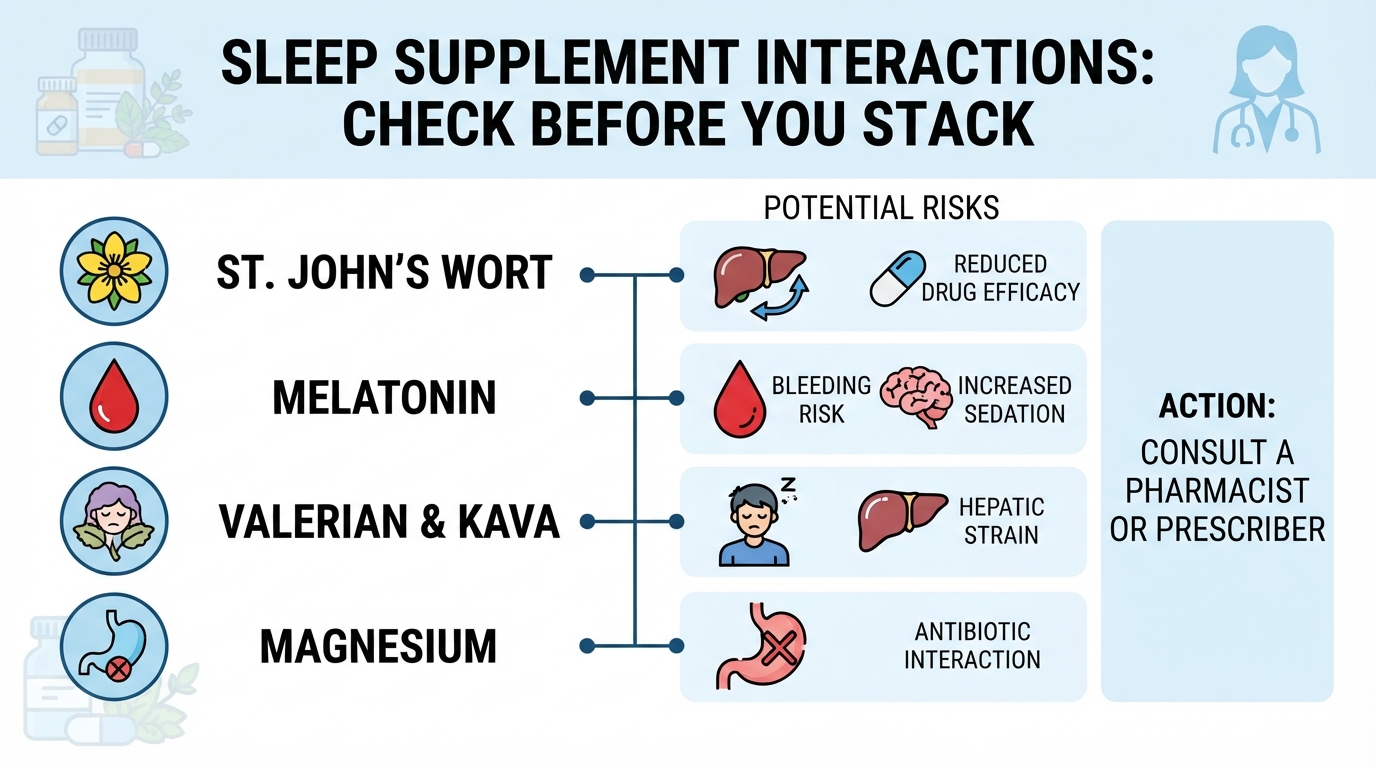
| Supplement | Watch Out With | What Can Happen |
|---|---|---|
| St. John’s wort | Many drugs, including antidepressants, birth control, warfarin, some statins, and transplant and HIV drugs | Weakens the drug; serotonin effects with SSRIs |
| Melatonin | Blood thinners, fluvoxamine, sedatives, immune-suppressing drugs | Bleeding risk; sharply higher melatonin levels; extra drowsiness |
| Valerian | Sedatives, alcohol, kava, St. John’s wort, melatonin | Extra drowsiness |
| Kava | Sedatives, alcohol, liver-affecting drugs | Extra drowsiness; liver strain |
| Magnesium | Tetracycline and quinolone antibiotics, bisphosphonates, some diuretics | Blocks absorption or changes drug levels |
| 5-HTP | SSRIs and other serotonergic drugs | Serotonin syndrome risk |
| Diphenhydramine | Sedating herbs, alcohol, other sedatives | Heavy drowsiness, confusion, especially in older adults |
Which Supplements Cause the Most Problems?
St. John’s wort
This herb has the strongest and best-documented interaction list. A 2020 review found it activates a receptor called PXR, which switches on liver enzymes, mainly CYP3A4, and a drug transporter called P-glycoprotein. Research linked this to altered levels of digoxin, tacrolimus, indinavir, warfarin, alprazolam, simvastatin, and oral contraceptives. The effect depends on how much hyperforin the preparation contains, so a low-hyperforin product interacts less. NCCIH says St. John’s wort can weaken birth control pills, cyclosporine, some seizure, heart, HIV, and cancer medicines, warfarin, certain statins, and some antidepressants. Combined with an SSRI, it can also push serotonin too high.
Melatonin
Melatonin has fewer interactions than most herbs, but a few matter. NCCIH advises anyone taking a blood thinner to use melatonin only under a doctor’s supervision, since melatonin can affect clotting. Fluvoxamine can raise melatonin levels sharply and cause heavy drowsiness. Melatonin can also work against immune-suppressing drugs and steroids. Caffeine raises melatonin levels, and smoking lowers them. See our melatonin guide.
Valerian and kava
The NIH says valerian might add to the effects of sedatives, and it advises against combining it with St. John’s wort, kava, and melatonin. NCCIH warns against taking valerian with alcohol or sedatives. Kava adds sedation too, and it carries a separate liver risk. Laboratory studies show kava can modulate liver enzymes, but researchers have found no documented human kava-drug pharmacokinetic interactions. The drowsiness and liver concerns remain. Read our valerian and kavaguides.
Magnesium
Magnesium can form insoluble complexes with tetracycline and quinolone antibiotics such as doxycycline, ciprofloxacin, and levofloxacin. The NIH Office of Dietary Supplements advises taking those antibiotics at least 2 hours before or 4 to 6 hours after a magnesium supplement. Magnesium can also interact with some diuretics, gabapentin, osteoporosis drugs, certain HIV drugs, acid reducers, and zinc and calcium supplements. See our magnesium guide.
5-HTP and other serotonin boosters
5-HTP, SAMe, and St. John’s wort all raise serotonin. Combining any of them with an SSRI can push serotonin too high and risk serotonin syndrome. Read our 5-HTP guide.
If you would like to see how we might be able to help you with this deeper, schedule a free consult here.
How to Check Your Own Combination Safely

- Write down everything. List every prescription, over-the-counter drug, supplement, and herb, with doses and timing. Include alcohol, caffeine, and nicotine.
- Ask a pharmacist. Pharmacists check interactions quickly and often at no charge.
- Tell your prescriber. Name every supplement at each visit, including ones you take only sometimes.
- Add one product at a time. If you start two at once, you cannot tell which one caused a problem.
- Check product quality. Look for third-party testing. See our supplements guide.
- Do not stop prescribed sleep medication on your own. Read our guide to stopping sleeping pills safely.
- Know the warning signs. Seek care for extreme drowsiness, confusion, fast heartbeat, agitation, unusual bruising or bleeding, yellowing skin, or a high fever with muscle stiffness.
Older adults face higher risk, because sedatives and sedating herbs stack up more easily with age. See our diphenhydramine guide for one example.
Want help organizing your list before you talk to your doctor? Book a consultation with The Sleep Consultant. We do not prescribe or check drug interactions as a clinical service, and we will help you prepare questions for your pharmacist or doctor.
What the Research Shows
St. John’s wort has the strongest interaction evidence. A 2020 review linked it to PXR activation and CYP3A4 and P-glycoprotein induction, with effects that scale with hyperforin content.
Sedating products stack. The NIH says valerian might add to sedatives and warns against pairing it with St. John’s wort, kava, and melatonin.
Melatonin needs care with blood thinners and fluvoxamine. NCCIH advises supervision with blood thinners, and fluvoxamine can raise melatonin levels sharply.
Magnesium blocks some antibiotics. The NIH Office of Dietary Supplements says to separate magnesium from tetracycline and quinolone antibiotics by at least 2 hours before or 4 to 6 hours after.
This article is for educational purposes only and is not a substitute for personalized medical advice, diagnosis, or treatment.
Want a Free Starting Point?
Join the free sleep course and community: Join the Sleep Nirvana Club
When to Seek Professional Help
- You take prescription medication and want to add any sleep supplement
- You take a blood thinner, antidepressant, antibiotic, or transplant medication
- You feel extremely drowsy, confused, or agitated after combining products
- You notice unusual bruising, bleeding, or yellowing skin
- You take several supplements and have never shown the full list to a pharmacist
Frequently Asked Questions

Can I take melatonin with my medications?
Often yes, but check first. Melatonin can raise bleeding risk with blood thinners, can rise sharply with fluvoxamine, and can add drowsiness to sedatives. NCCIH advises anyone on a blood thinner to use melatonin only under a doctor’s supervision.
Is St. John’s wort safe with antidepressants?
No, not without medical guidance. It can push serotonin too high when combined with an SSRI, and it also speeds up how your liver clears many drugs, which can weaken them.
Can I take magnesium with antibiotics?
Magnesium can block absorption of tetracycline and quinolone antibiotics. The NIH Office of Dietary Supplements advises taking those antibiotics at least 2 hours before or 4 to 6 hours after a magnesium supplement.
Is valerian safe to combine with sleeping pills?
Valerian might add to the effects of sedatives, and NCCIH advises against taking it with alcohol or sedatives. Check with your prescriber before combining it with any sleep medication.
Who should check supplement interactions first?
A pharmacist is the fastest check, and your prescriber should review your list at each visit. Older adults and anyone taking several medications need to check most carefully.
When to Work With a Sleep Consultant
Supplements can help or hurt, depending on what else you take. If you want a safer, simpler plan built around evidence, we can help you prepare for the right conversation with your pharmacist or doctor.


