

Benzodiazepines for sleep are sedative-hypnotic medicines that help many people fall asleep faster in the short term, but they are meant for brief use. Several are FDA-approved for insomnia, including temazepam, triazolam, estazolam, flurazepam, and quazepam, while others such as alprazolam and lorazepam are not. Experts advise limiting use to about 4 weeks or less, because the sleep benefit fades while risks of dependence, falls, memory problems, and overdose remain. The Beers Criteria say older adults should generally avoid them, and the FDA’s boxed warning covers abuse, addiction, dependence, and withdrawal. Combining them with opioids, alcohol, or other sedatives can slow breathing dangerously. Do not stop long-term use suddenly; taper with your prescriber, and consider CBT-I, the first-line treatment. This is educational information, not medical advice.
What are benzodiazepines for sleep?
Benzodiazepines are a class of medicines with sedative, anti-anxiety, muscle-relaxant, and anticonvulsant effects. Primary care doctors often use them for rapid, short-term relief of insomnia, for which their short-term effect is well established.
Not all benzodiazepines are approved for insomnia. Here is where they stand:
- FDA-approved for insomnia: estazolam, flurazepam, temazepam, triazolam, and quazepam.
- Often used off-label for sleep: alprazolam, lorazepam, clonazepam, diazepam, and others.
- Typical advice: use only briefly. A 2024 review advises avoiding prescribing them for insomnia for longer than 4 weeks.
- The FDA boxed warning: in 2016 it was added about the risk of death when combined with opioids. In September 2020 it was updated to include the potential for abuse, addiction, and other serious risks.
- Older adults: the 2019 American Geriatrics Society Beers Criteria strongly recommend avoiding them.
They differ in how long they last. Short-acting types such as triazolam and temazepam act quickly and clear sooner. Long-acting types such as flurazepam last longer in the body.
Do benzodiazepines work for insomnia?
In the short term, yes. Meta-analyses comparing benzodiazepines with placebo show improvements in sleep quality and fewer nighttime awakenings. But the evidence in those trials is rated insufficient or low strength, and there is not enough evidence to support long-term use.
The benefit also fades. A 2024 review notes that these drugs start to lose their efficacy for insomnia after about 4 weeks, while the risks of side effects and addiction remain. In older adults, many temazepam trials show improvement in the time it takes to fall asleep, but not in total sleep time.
Stopping can also bring rebound symptoms, which means the original problem comes back for a while.
What are the risks and side effects of benzodiazepines?
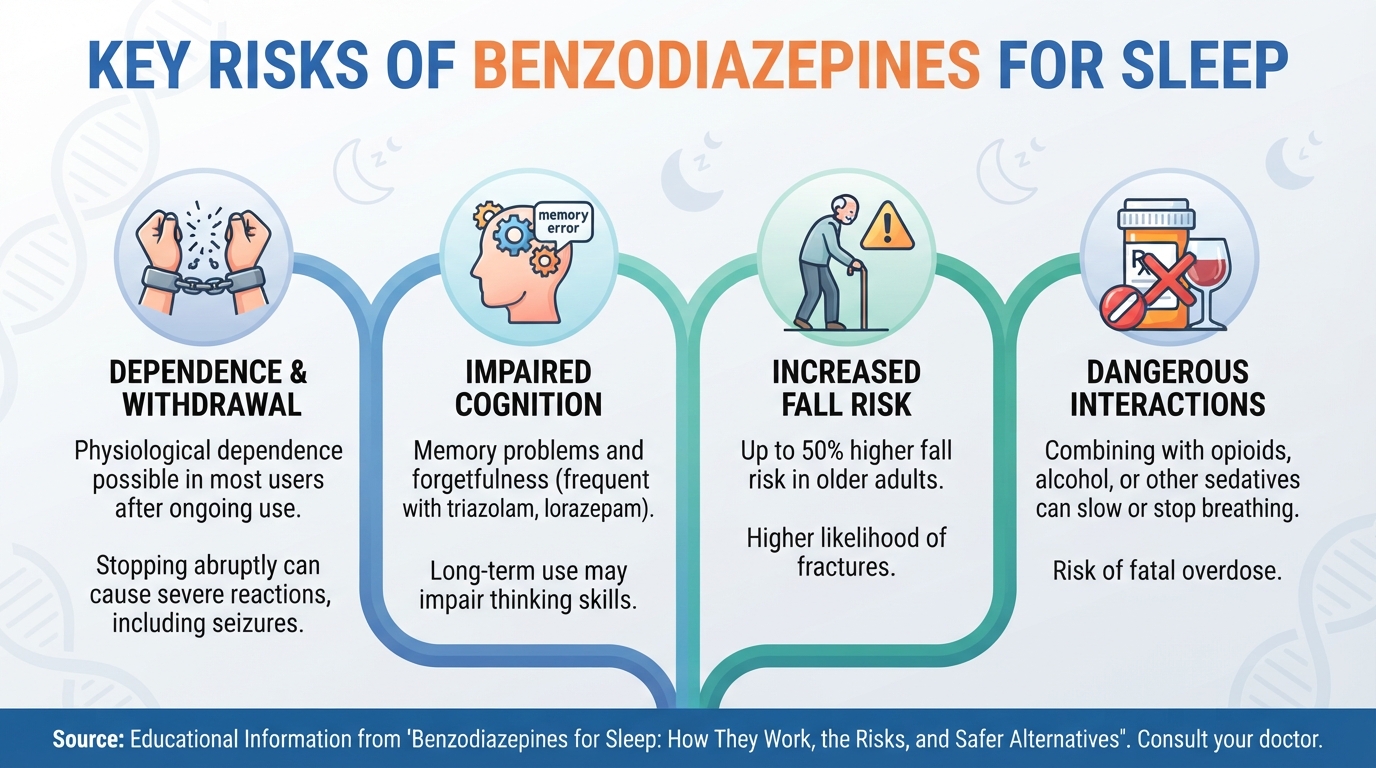
The risks increase with age and with how long you take them.
- Dependence and withdrawal. With ongoing use, all benzodiazepines can produce physiological dependence in most people. Stopping can cause withdrawal.
- Abuse and misuse. The FDA boxed warning covers abuse, misuse, addiction, physical dependence, and withdrawal reactions.
- Falls and fractures. One review reports that benzodiazepines raise the risk of falling by about 50% in older adults. Another found a twofold higher fall risk in South Korean patients, and a 50% to 110% higher fracture risk.
- Memory and thinking problems. Memory loss is most frequent with triazolam and lorazepam. Long-term use may impair thinking, and cognitive function often improves after tapering or stopping.
- Complex sleep behaviors, such as sleepwalking.
- Impaired driving and car crashes, especially in older adults.
- Dangerous breathing effects. Combining benzodiazepines with opioids increases the risk of respiratory depression and death. They can also worsen breathing in people with COPD or sleep apnea.
- Pregnancy and breastfeeding. Risks to the baby are a concern.
To keep this in perspective, most people who take benzodiazepines do not develop a use disorder. In a US survey, 12.5% of adults used benzodiazepines, 17.1% of users misused them, and fewer than 2% of users met the criteria for a benzodiazepine use disorder.
Who should avoid benzodiazepines for sleep?
Talk with a prescriber before using one if you:
- Are 65 or older. The Beers Criteria strongly recommend avoiding them, because older adults are more sensitive to the effects and clear the drugs more slowly.
- Have sleep apnea, COPD, or other breathing problems. See our complete guide to sleep apnea.
- Take opioids, or drink alcohol or use other sedatives.
- Have a history of substance use disorder.
- Are pregnant or breastfeeding.
- Have had falls, memory problems, or cognitive impairment.
- Drive or operate machinery.
How do benzodiazepines compare with Z-drugs and other options?
None is risk-free. The Beers Criteria discourage both benzodiazepines and Z-drugs such as zolpidem for older adults. Read about Ambien side effects, trazodone for sleep, and gabapentin for sleep for the other common choices.
Guidelines point to CBT-I first. Read about CBT-I. For the big picture, see our guide to sleeping pills and sleep medications.
Can you stop benzodiazepines safely?

Only with a plan. After months or years of use, stopping can cause withdrawal symptoms such as seizures, insomnia, nightmares, and psychosis, so slower tapers may be best. The FDA warns that abrupt discontinuation or too-rapid dose reduction can cause serious withdrawal reactions, including seizures, which can be life-threatening.
Talk with your prescriber about a gradual, carefully monitored taper, and consider CBT-I so you have non-drug tools. Our guide on how to stop taking sleeping pills covers the general principles.
Wondering whether a medicine is the right tool for your sleep, or what is driving your insomnia in the first place? Book a consultation and we’ll look for the root causes alongside your prescriber.
What should you ask your doctor about benzodiazepines for sleep?
- Why a benzodiazepine rather than another option, and for how long?
- Have I tried CBT-I, or can you refer me?
- Does it interact with my other medicines, opioids, or alcohol?
- Does my age, breathing, or fall risk make it a poor choice?
- What side effects should I watch for, and when should I get urgent help?
- When will we review it, and what is the plan for stopping?
What the Research Shows
Short-term benefit, long-term doubt. Meta-analyses of trials comparing benzodiazepines with placebo found significant improvement in sleep quality and fewer nighttime awakenings, but the evidence was insufficient or low strength, and the authors concluded there is not enough evidence to support long-term use. A 2024 Cleveland Clinic Journal of Medicine review says these drugs start to lose their efficacy for insomnia after about 4 weeks, while the risks of side effects and addiction remain. Many temazepam trials in older adults show improvement in sleep onset latency but none in total sleep time.
Falls and fractures are a major concern. A psychiatry review reported that benzodiazepines raise the risk of falling by about 50% in older adults. The 2024 review cites a South Korean study with a twofold higher fall risk and data suggesting a 50% to 110% higher fracture risk, and estimates the population risk of serious falls attributable to long-term use at about 3%. The Beers Criteria warn that all benzodiazepines increase the risk of cognitive impairment, delirium, falls, fractures, and motor vehicle crashes in older adults.
Dependence and misuse are real, but not universal. The FDA added a boxed warning in 2016 about combining benzodiazepines with opioids, and updated it in September 2020 to include abuse, addiction, and other serious risks. Clinicians note that with ongoing use, all benzodiazepines produce physiological dependence in most patients. Yet national survey data show that among the 12.5% of US adults who used benzodiazepines, 17.1% misused them and fewer than 2% met criteria for a use disorder.
Guidelines prefer CBT-I and short use. The Cleveland Clinic review notes that clinical guidelines recommend cognitive behavioral therapy as first-line treatment, and says benzodiazepines should be used judiciously and not for insomnia beyond 4 weeks. For people already on long-term therapy, it advises shared decision-making and a gradual, carefully monitored taper. Some experts suggest intermittent rather than nightly use to lower risk, though that remains a prescriber’s decision.
This article is for education only and is not medical advice. Talk with a qualified clinician about your own sleep, health conditions, and medications.
If you would like to see how we might be able to help you with this deeper, schedule a free consult here.
Want a hand building non-drug sleep skills?
Join The Sleep Nirvana Club, our free sleep course and community: Join the free sleep course and community.
When to Seek Professional Help
- Get emergency help for slowed or shallow breathing, extreme sleepiness, being unable to wake the person, confusion, or seizures, especially if opioids or alcohol were also used.
- You have taken a benzodiazepine for weeks or longer and want to stop. Do not stop suddenly. Talk with your prescriber about a taper.
- You or an older family member has had falls, memory problems, confusion, or daytime drowsiness on a benzodiazepine. Ask for a medication review.
- You have trouble sleeping at least three nights a week for three months or more. Ask about CBT-I.
- You are taking more than prescribed, craving the medicine, or feel persistently sad or hopeless, or have thoughts of self-harm. Contact a clinician right away, and in the US you can call or text 988 at any time.
Frequently Asked Questions
Are benzodiazepines good for sleep?
They can help you fall asleep faster and wake less in the short term, but they are not a long-term fix. Several benzodiazepines are FDA-approved for insomnia, and meta-analyses show better sleep quality, though the evidence is low strength. The benefit starts to fade after about four weeks, while risks such as dependence, falls, memory problems, and overdose remain. CBT-I is the first-line treatment for chronic insomnia.
How long can you take benzodiazepines for sleep?
Experts generally advise using benzodiazepines for insomnia for no longer than about four weeks, because the sleep benefit tends to fade while risks remain. Older adults are advised to avoid them in most cases. If you have taken one for longer, do not stop suddenly. Talk with your prescriber about a gradual plan, and consider CBT-I to help you sleep without medicine. Always ask when your prescription will be reviewed.
Which benzodiazepines are approved for insomnia?
The benzodiazepines with an FDA-approved indication for insomnia are estazolam, flurazepam, temazepam, triazolam, and quazepam. Others, such as alprazolam, lorazepam, clonazepam, and diazepam, are sometimes used for sleep but are off-label for insomnia. Short-acting types such as triazolam and temazepam act quickly and clear sooner, while long-acting types may leave you drowsy longer. Your prescriber chooses based on your health and other medicines.
Are benzodiazepines safe for older adults?
Generally not. The American Geriatrics Society Beers Criteria strongly recommend that older adults avoid benzodiazepines, because they raise the risk of cognitive impairment, delirium, falls, fractures, and car crashes. Studies suggest benzodiazepines raise the risk of falls by about 50% to twofold in older adults. If an older adult already takes one, ask the prescriber about a slow, supervised taper and safer alternatives such as CBT-I.
Can you stop benzodiazepines suddenly?
No. Stopping a benzodiazepine suddenly after weeks or longer can cause withdrawal symptoms, including insomnia, nightmares, anxiety, seizures, and psychosis, and the FDA warns that abrupt discontinuation or fast dose reduction can be dangerous. Prescribers usually lower the dose gradually and carefully monitor you, often adding CBT-I. Do not make changes on your own. Our guide on stopping sleeping pills covers the general principles.
When to Work With a Sleep Consultant
We do not prescribe or adjust medicines, and your prescriber should lead any decision about benzodiazepines. What The Sleep Consultant can do is work alongside them. We look for the root causes of your insomnia, such as your circadian rhythm, stress response, hormones, gut, or nutrient status, and help you build the non-drug skills that make coming off sleeping pills more likely to stick.


