

REM sleep behavior disorder (RBD) means you act out vivid dreams. You may shout, kick, punch, or fall out of bed. In normal REM sleep, your body stays temporarily paralyzed while you dream. In RBD, that paralysis fails. Doctors confirm the diagnosis with an overnight sleep study that shows REM sleep without atonia (loss of muscle paralysis). RBD deserves a medical visit for two reasons. It can injure you or your partner, and in many people it is an early marker of a brain condition such as Parkinson’s disease or Lewy body dementia. In the largest study of people with isolated RBD, about 73 percent developed one of these conditions within 12 years. That is a risk, not a certainty, and a doctor can help you weigh it. This is educational information, not medical advice.
Short answer (40-60 words): REM sleep behavior disorder means acting out vivid dreams because the normal muscle paralysis of REM sleep fails. Doctors diagnose it with an overnight sleep study. It needs a medical visit because it can cause injury and often signals a later brain condition, so treatment and safety planning matter.
What Happens in RBD?
During REM sleep, your brain dreams while your muscles stay still. That temporary paralysis, called atonia, keeps you from moving as you dream. In RBD, atonia is incomplete. The International Classification of Sleep Disorders (ICSD-3-TR) requires repeated episodes of sleep-related vocalization or complex movements, plus a sleep study showing REM sleep without atonia.
Typical signs include:
- Shouting, swearing, or laughing during sleep
- Punching, kicking, or flailing
- Jumping or falling out of bed
- Dreams of being chased or attacked that match your movements
- Episodes mostly in the second half of the night, when REM sleep is longest
- Waking quickly and recalling a vivid, action-filled dream
A bed partner often notices first.
How Is It Different From Other Sleep Problems?
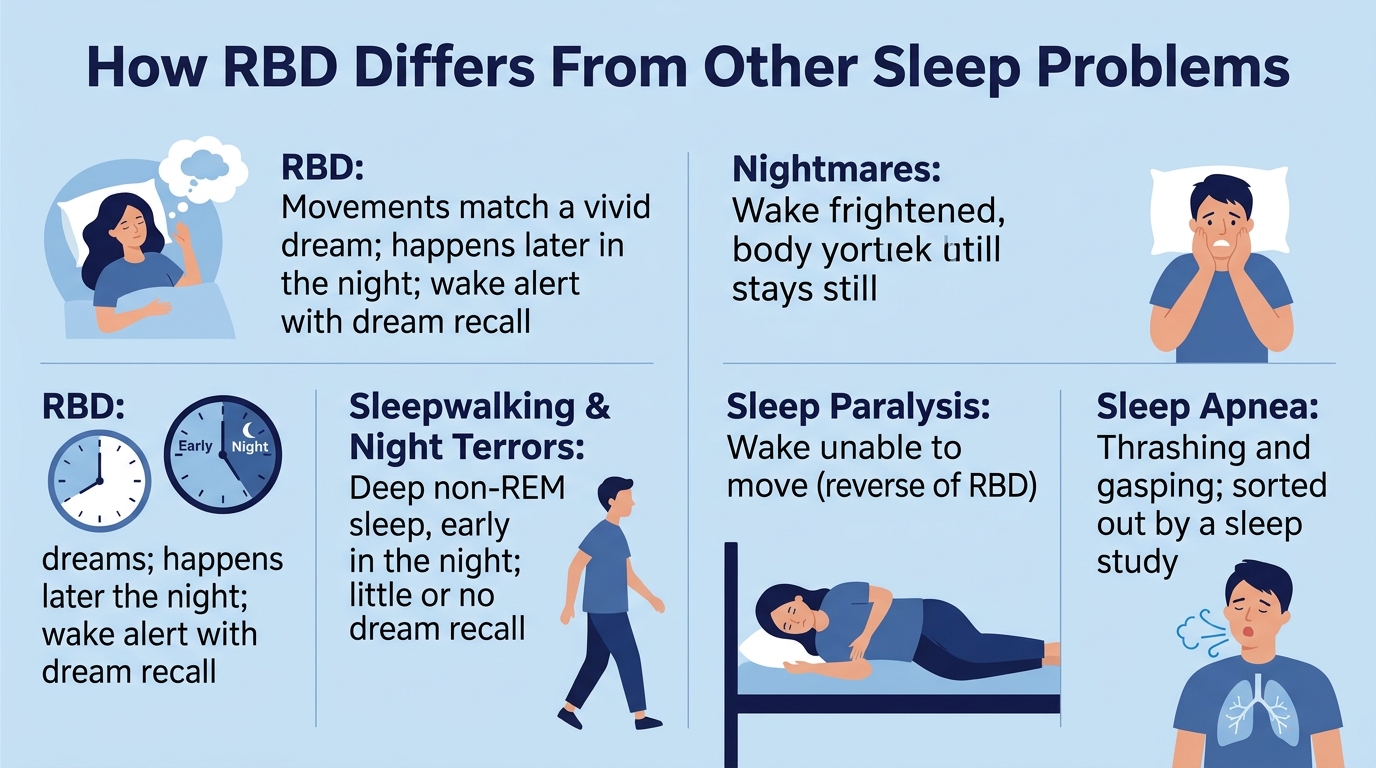
| Condition | Key Difference |
|---|---|
| RBD | Movements match a vivid dream; you wake alert and recall it; happens later in the night |
| Sleepwalking and night terrors | Occur in deep non-REM sleep, early in the night; little or no dream recall |
| Nightmares | You wake frightened, but your body stays still |
| Sleep paralysis | You wake but cannot move; the reverse of RBD |
| Sleep apnea | Can cause thrashing and gasping; a sleep study sorts it out |
Sleep apnea and other conditions can mimic RBD behaviors, and RBD can occur alongside narcolepsy or after certain medications. That is why a sleep study is part of the diagnosis, and why doctors review your medications as well. See our guides on sleep paralysis and insomnia or sleep apnea.
Why Does RBD Need a Medical Visit?
Injury
Dream enactment can cause bruises, cuts, broken bones, and injuries to a bed partner. Safety planning matters even before a diagnosis.
Link to Brain Conditions
RBD often shows up years before conditions called alpha-synucleinopathies, including Parkinson’s disease, dementia with Lewy bodies, and multiple system atrophy. The largest multicenter study followed over 1,000 people with isolated RBD and found a 6.3 percent yearly rate of conversion, with 73.5 percent converting within 12 years of diagnosis. The American Academy of Sleep Medicine’s provider fact sheet reports that between 70 and 91 percent of people with isolated RBD eventually develop one of these conditions.
The link also works in reverse. In one clinic study, 77 percent of 540 people with Parkinson’s disease had RBD, and more than 89 percent of people with dementia with Lewy bodies or multiple system atrophy did.
Put these numbers in context. These figures come from specialty clinic cohorts, so they may overstate the risk for the average person. The AASM advises that doctors assess risk case by case. No test or treatment can tell you your own outcome with certainty. Some people want to know their risk, and some do not. A doctor can help you decide how to approach it. Researchers are still designing studies of treatments that might protect the brain, and no such treatment is established.
How Do Doctors Diagnose RBD?

Diagnosis rests on your history and a sleep study. A video-polysomnography records your muscle activity, and the report should show the percentage of REM sleep with loss of atonia. Video can capture any dream-enactment behavior. Our overnight sleep study guide explains what the night involves. Doctors often review medications and treat conditions like sleep apnea first, then reassess.
A sleep medicine physician or neurologist usually leads the evaluation.
How Is RBD Treated?

Treatment focuses on safety and on reducing episodes. No treatment eliminates dream enactment in most people, but treatment can lower how often and how severe it gets, and can lower the chance of injury.
- Bedroom safety. Doctors prioritize this first. Common steps include removing sharp or heavy objects near the bed, padding hard edges, lowering the mattress, protecting windows, and sleeping separately while episodes continue.
- Medication. The two most prescribed options are bedtime clonazepam and high-dose melatonin. The melatonin doses used for RBD are much higher than typical store-bought doses, so do not try to self-treat. Product quality varies, as our melatonin dosage article explains. Clonazepam is a benzodiazepine, and the AGS Beers Criteria advise avoiding benzodiazepines in older adults, so your doctor will weigh the risks. See sleeping pills for older adults.
- Ongoing follow-up. Many neurologists track movement, cognition, and other early signs over time.
Worried about a partner’s or your own nighttime behavior? Book a consultation with The Sleep Consultant. We cannot diagnose or treat RBD, and we will help you organize what you have seen and prepare for a visit with a sleep physician or neurologist.
What the Research Shows
RBD requires a sleep study. ICSD-3-TR criteria require repeated dream-enactment episodes and polysomnographic evidence of REM sleep without atonia.
RBD often precedes brain conditions. The largest multicenter study found a 6.3 percent yearly conversion rate and 73.5 percent conversion within 12 years, and the AASM reports 70 to 91 percent eventual conversion.
RBD is common in these conditions. One clinic study found RBD in 77 percent of Parkinson’s patients and in more than 89 percent of patients with dementia with Lewy bodies or multiple system atrophy.
Treatment reduces risk but rarely cures. Clonazepam and melatonin reduce the frequency and severity of episodes and the chance of injury, but complete elimination is rare.
This article is for educational purposes only and is not a substitute for personalized medical advice, diagnosis, or treatment.
If you would like to see how we might be able to help you with this deeper, schedule a free consult here.
Want a Free Starting Point?
Join the free sleep course and community: Join the Sleep Nirvana Club
When to Seek Professional Help
- You or a partner see repeated shouting, punching, or kicking during sleep
- You or your partner have been injured during sleep
- Dream enactment began or got worse after a new medication
- You also notice changes in movement, smell, memory, or constipation
- Your partner feels unsafe sharing a bed
Frequently Asked Questions
What is REM sleep behavior disorder?
RBD is a sleep disorder in which you physically act out vivid dreams because the normal muscle paralysis of REM sleep is incomplete. You may shout, punch, kick, or fall out of bed. A sleep study confirms the diagnosis.
Does REM sleep behavior disorder mean I will get Parkinson’s disease?
Not necessarily, but it raises the risk. In the largest study of people with isolated RBD, about 73 percent developed Parkinson’s disease or a related condition within 12 years. Those figures come from specialty clinics, and a doctor can help you weigh your own risk.
How do doctors test for RBD?
Doctors use your history and an overnight video-polysomnography that shows REM sleep without atonia. They also review your medications and check for conditions like sleep apnea that can mimic RBD.
Can RBD be treated?
Yes, but not cured in most cases. Safety changes in the bedroom come first. Doctors often prescribe bedtime clonazepam or high-dose melatonin, which reduce how often and how severe episodes are and lower injury risk.
Is acting out dreams the same as sleepwalking?
No. Sleepwalking happens in deep non-REM sleep, usually early in the night, with little dream recall. In RBD, movements match a vivid dream, happen later in the night, and you often wake alert and recall the dream.
When to Work With a Sleep Consultant
RBD needs a medical evaluation first. If you want help organizing what you have noticed and preparing for that visit, we can help.


