

Glycine for sleep is a supplement based on an amino acid your body already makes, and a few small trials, using 3 grams before bed, suggest it may improve sleep quality. In one sleep study, it improved subjective sleep quality and shortened the time to fall asleep, possibly by lowering core body temperature. The evidence is limited: the studies were small, short, and some were run by researchers tied to a glycine manufacturer. Glycine is generally well tolerated in studies, with nausea at high doses, but supplements are not tested like drugs. Ask a clinician first if you are pregnant, breastfeeding, or taking medicines, and do not confuse glycine with magnesium glycinate. CBT-I is the first-line treatment for chronic insomnia. This is educational information, not medical advice.
Why do people take glycine for sleep?
Glycine is a non-essential amino acid, which means your body makes it. The body synthesizes roughly 45 grams a day, and people also get about 3 to 5 grams a day from food, such as meat, eggs, milk, lentils, tofu, and bone broth. It also plays a role in how brain cells signal, including through inhibitory glycine receptors.
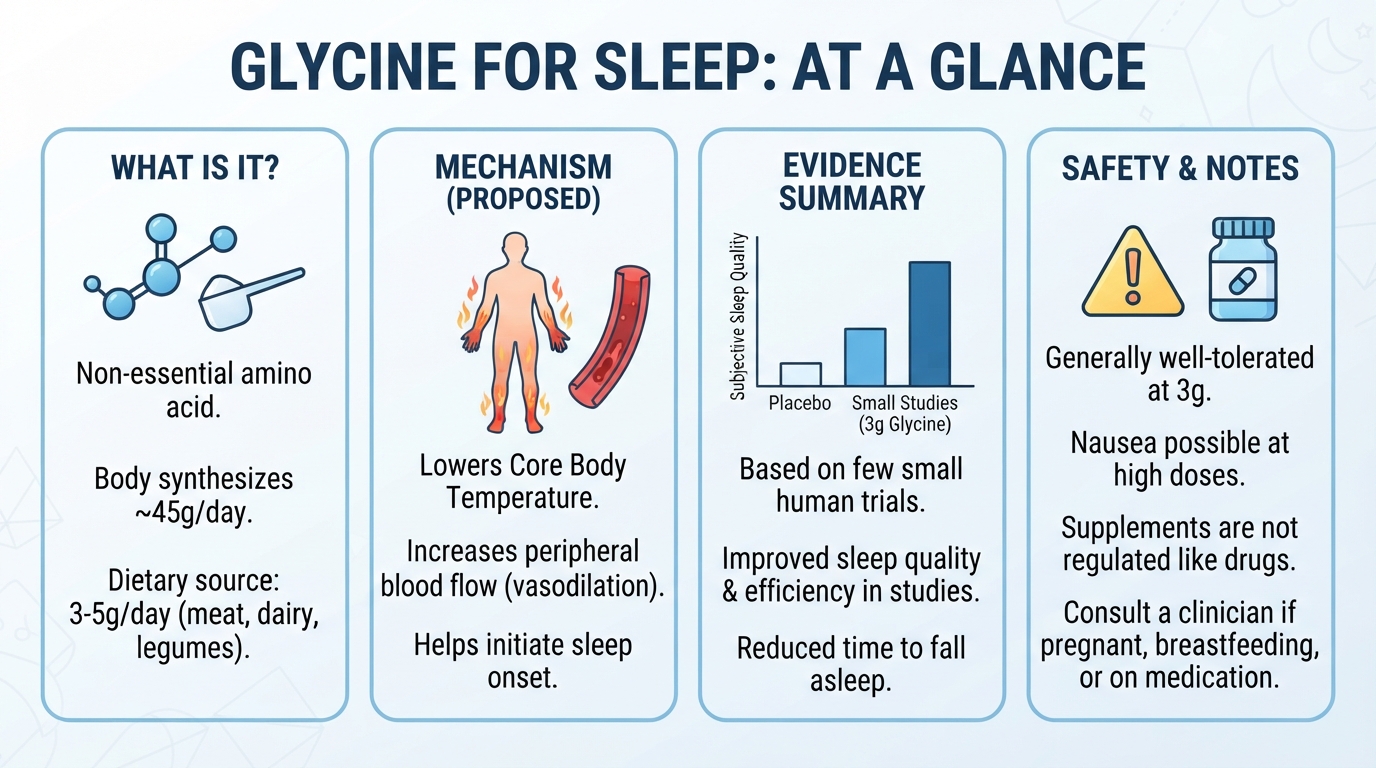
It is sold as a powder or capsule, and marketed for insomnia and sleep quality. Here is glycine for sleep at a glance:
- What it is: a non-essential amino acid. Most people eat about 3 to 5 grams a day.
- Possible mechanism: a drop in core body temperature helps start sleep, and glycine may lower it by widening blood vessels. This comes mostly from animal studies.
- Evidence: three small human studies using 3 grams before bed, with some authors tied to a glycine manufacturer.
- Safety: no side effects at 3 grams in studies, nausea at high doses, and no requirement for supplements to prove safety.
- Not the same as magnesium glycinate, which combines magnesium with glycine.
Does glycine help you sleep?
Possibly, a little, but the evidence is thin. The Sleep Foundation notes that glycine is often promoted as a cure for insomnia, yet there is not much evidence to back that up, and that three small human studies suggest it may hold promise.
What those studies found:
- A 2006 trial (randomized, double-blind crossover) gave volunteers with sleep complaints 3 grams of glycine or placebo before bed. Glycine improved the next-morning feelings of fatigue, liveliness, and clear-headedness.
- A 2007 trial measured sleep with polysomnography in people with ongoing unsatisfactory sleep. Glycine (3 grams before bed) improved subjective sleep quality and sleep efficiency (time asleep divided by time in bed), shortened the time to fall asleep and to reach slow-wave sleep, and did not change sleep architecture. It also lessened daytime sleepiness and improved a memory recognition task.
- A 2012 crossover study tested 3 grams of glycine against placebo 30 minutes before bedtime during three nights of sleep restricted by about 25%. Only seven people were analyzed, so it is too small to settle anything.
That is a promising pattern, but small and short.
How might glycine work?

The leading idea involves body temperature. Falling asleep is linked to a drop in core body temperature, and a low temperature is maintained during sleep. In rats, glycine decreased core body temperature and increased blood flow in the skin, and researchers think this may underlie its effects on sleep. Other animal work points to receptors in the brain’s body clock region and to higher serotonin in the brain.
Human evidence for these mechanisms is much thinner. For another sleep tool that works with the body’s cooling cycle, see our article on a warm bath before bed.
Is glycine safe?
In the short studies, yes, but long-term data are limited.
- At 3 grams, the human studies reported no side effects.
- At high doses, nausea may occur. Amounts as high as 31 grams were studied for safety in volunteers, though that does not make high doses a good idea.
- Supplements are not tested like drugs. Manufacturers do not have to prove glycine is safe before selling it.
- Excessive amounts can be toxic, according to one health source, so check with a clinician.
- Ask first if you are pregnant, breastfeeding, or taking medicines.
How does glycine compare with magnesium glycinate and L-theanine?
They are different products:
- Glycine is a standalone amino acid. Sleep studies used glycine itself.
- Magnesium glycinate combines elemental magnesium with glycine. See magnesium for sleep.
- L-theanine is a separate amino acid, often paired with glycine. See L-theanine and glycine for sleep.
For the bigger picture, see our honest guide to supplements for sleep and our look at chamomile tea for sleep.
Wondering whether a supplement is really what you need, or what is driving your poor sleep in the first place? Book a consultation and we’ll look for the root cause.
How could you try glycine for sleep, if you decide to?

This is practical information from studies, not a recommendation. Talk with a clinician or pharmacist first.
- Check with a clinician if you are pregnant, breastfeeding, or taking medicines.
- Know what the studies used. The trials gave 3 grams, and sources typically suggest taking it 30 to 60 minutes before bed.
- Choose a product you can verify. Supplements vary, and labels should list only what you expect.
- Track for two weeks. Note how long it takes to fall asleep and how you feel in the morning.
- Stop if you feel unwell, such as nausea.
- If nothing changes, move on. Do not raise the amount.
- Build the basics. A steady schedule, morning light, and a wind-down routine matter more.
What works better first?
For chronic insomnia, CBT-I is the first-line treatment recommended by the American College of Physicians. Supplements are optional extras, not substitutes. Read about CBT-I.
What the Research Shows
A 2007 trial gave the clearest signal. Yamadera and colleagues studied volunteers who had been continuously experiencing unsatisfactory sleep. Glycine (3 grams) before bedtime improved subjective sleep quality and sleep efficiency, and shortened polysomnography latency to sleep onset and to slow-wave sleep, without changes in sleep architecture. It also lessened daytime sleepiness and improved memory recognition. The authors concluded that glycine seems to improve sleep quality in a different way than traditional hypnotics such as benzodiazepines.
The other human studies were small. A 2006 randomized double-blind crossover trial in volunteers with sleep complaints found improvements in next-morning fatigue, liveliness, and clear-headedness after 3 grams of glycine. A 2012 randomized single-blinded crossover trial analyzed seven people during three nights of 25% restricted time in bed, with 3 grams of glycine or placebo given 30 minutes before bedtime. Together, they are suggestive but small.
The mechanism evidence is mostly from animals. In rats, glycine decreased core body temperature and increased vasodilatation, and the authors of a 2012 review proposed that a decline in core temperature might underlie its effects on sleep. Further animal work implicates NMDA receptors in the suprachiasmatic nucleus, the brain’s master clock, and increased serotonin in the brain. These findings may not carry over to people.
The limits are significant. The Sleep Foundation notes that the researchers in the human studies included people who work for a company that makes glycine supplements, and that the number of subjects was small. It says that glycine may hold promise but that evidence to back up claims that it cures insomnia is lacking.
This article is for education only and is not medical advice. Talk with a qualified clinician about your own sleep, health conditions, and medications.
If you would like to see how we might be able to help you with this deeper, schedule a free consult here.
Want a hand building a calmer evening routine?
Join The Sleep Nirvana Club, our free sleep course and community: Join the free sleep course and community.
When to Seek Professional Help
- You have trouble sleeping at least three nights a week for three months or more. Ask about CBT-I, the first-line treatment for chronic insomnia.
- You feel nauseated or unwell after starting glycine. Stop it, and talk with a clinician if symptoms continue.
- You are pregnant or breastfeeding, or you take medicines, including for mental health conditions, and want to use a supplement. Ask a clinician or pharmacist first.
- You snore loudly, gasp at night, or feel very sleepy by day. These can signal sleep apnea.
- You feel persistently sad or hopeless, or have thoughts of self-harm. Contact a clinician right away, and in the US you can call or text 988 at any time.
Frequently Asked Questions
Does glycine help you sleep?
It may help a little, but the evidence is limited. A few small trials using 3 grams before bed found better subjective sleep quality, less next-day fatigue, and a shorter time to fall asleep on sleep-study measures in people with sleep complaints. The studies were small and short, and some were run by researchers tied to a glycine manufacturer. Treat it as a low-risk experiment, not a treatment for insomnia, and ask a clinician first if you take medicines.
How much glycine should you take for sleep?
There is no medically established dose. The small trials used 3 grams taken before bedtime, and the Sleep Foundation notes people typically take it 30 to 60 minutes before bed. People get about 3 to 5 grams a day from food. Higher amounts can cause nausea. Supplements are not tested like drugs, so ask a clinician or pharmacist before starting, especially if you are pregnant, breastfeeding, or taking medicines.
Is glycine safe to take every night?
In the short studies, 3 grams caused no side effects, and amounts up to about 31 grams were studied for safety, though high doses may cause nausea. Long-term nightly safety data are limited, and supplements do not have to prove safety before they are sold. If you are pregnant, breastfeeding, or taking medicines, check with a clinician first. Stop if you feel unwell.
What is the difference between glycine and magnesium glycinate?
Glycine is a standalone amino acid. Magnesium glycinate is a supplement that combines elemental magnesium with glycine. They are different products, and the sleep research on glycine used glycine itself. Magnesium has its own evidence and cautions. Check labels to see what you are buying, and ask a clinician if you are unsure.
How long does glycine take to work?
Studies measured effects the same night or the next morning, and glycine is usually taken 30 to 60 minutes before bed. Some sources say consistent use for a few weeks may bring cumulative benefits, but the research on long-term effects is limited. If you notice no change after a couple of weeks, move on rather than raising amounts, and focus on CBT-I and sleep habits.
When to Work With a Sleep Consultant
If you have tried supplements and still sleep poorly, a deeper cause may be involved: your circadian rhythm, stress response, hormones, gut, or nutrient status. The Sleep Consultant looks for those root causes instead of handing you another supplement.


