

Orexin antagonists for insomnia, also called dual orexin receptor antagonists or DORAs, work by blocking orexin, a brain signal that keeps you awake. Three are FDA-approved: suvorexant (Belsomra), lemborexant (Dayvigo), and daridorexant (Quviviq). Meta-analyses show they beat placebo on most sleep measures, with downsides including next-day sleepiness, abnormal dreams, fatigue, and dry mouth. Sleep paralysis and hallucinations are rarer side effects, and they are not for people with narcolepsy. Unlike benzodiazepines and Z-drugs, DORAs have not been linked to physiological dependence, but they are not risk-free and long-term data are limited. CBT-I remains the first-line treatment for chronic insomnia. Ask your prescriber about driving, alcohol, and other medicines before starting. Do not stop or change a prescribed dose on your own. This is educational information, not medical advice.
What are orexin antagonists for insomnia?
Orexin, also called hypocretin, is a brain chemical that promotes wakefulness. It acts on two receptors, called OX1R and OX2R. Dual orexin receptor antagonists (DORAs) block both, which quiets the wake signal and makes it easier to fall and stay asleep.
DORAs emerged more than a decade ago with the prospect of being a safer option for insomnia than older drug classes. Three are now FDA-approved in the US: suvorexant (Belsomra), approved in 2014, lemborexant (Dayvigo), approved in 2019, and daridorexant (Quviviq), the most recent, approved in 2022.
Here is orexin antagonists for insomnia at a glance:
- How they work: they block orexin receptors, which promote wakefulness.
- Approved drugs: Belsomra (suvorexant), Dayvigo (lemborexant), and Quviviq (daridorexant).
- Evidence: better than placebo on most sleep measures in meta-analyses.
- Common side effects: next-day sleepiness, abnormal dreams, fatigue, and dry mouth.
- Less common: sleep paralysis and hallucinations, which resemble narcolepsy symptoms.
- Dependence: not linked to physiological dependence in a 2025 meta-analysis.
- Stopping: a 2023 expert guideline sees no need to taper DORAs, but ask your prescriber.
Do orexin antagonists work?
They work better than placebo, though the effects are moderate and most trials last weeks to months.
A 2022 network meta-analysis in Sleep Medicine Reviews found that DORAs were superior to placebo in all efficacy outcomes except the subjective number of awakenings. A 2023 network meta-analysis of 10 trials with 7,806 patients found that the higher doses of lemborexant and suvorexant each reduced time awake after sleep onset by about 25 minutes at one month, and noted that dosing may play an important role. Trials measure sleep with both diaries and sleep studies, and most follow people for a few months, not years.
The benefit is real but not dramatic, and individual responses vary. CBT-I remains the first-line treatment. Read about CBT-I.
Belsomra vs Dayvigo vs Quviviq: how do they compare?
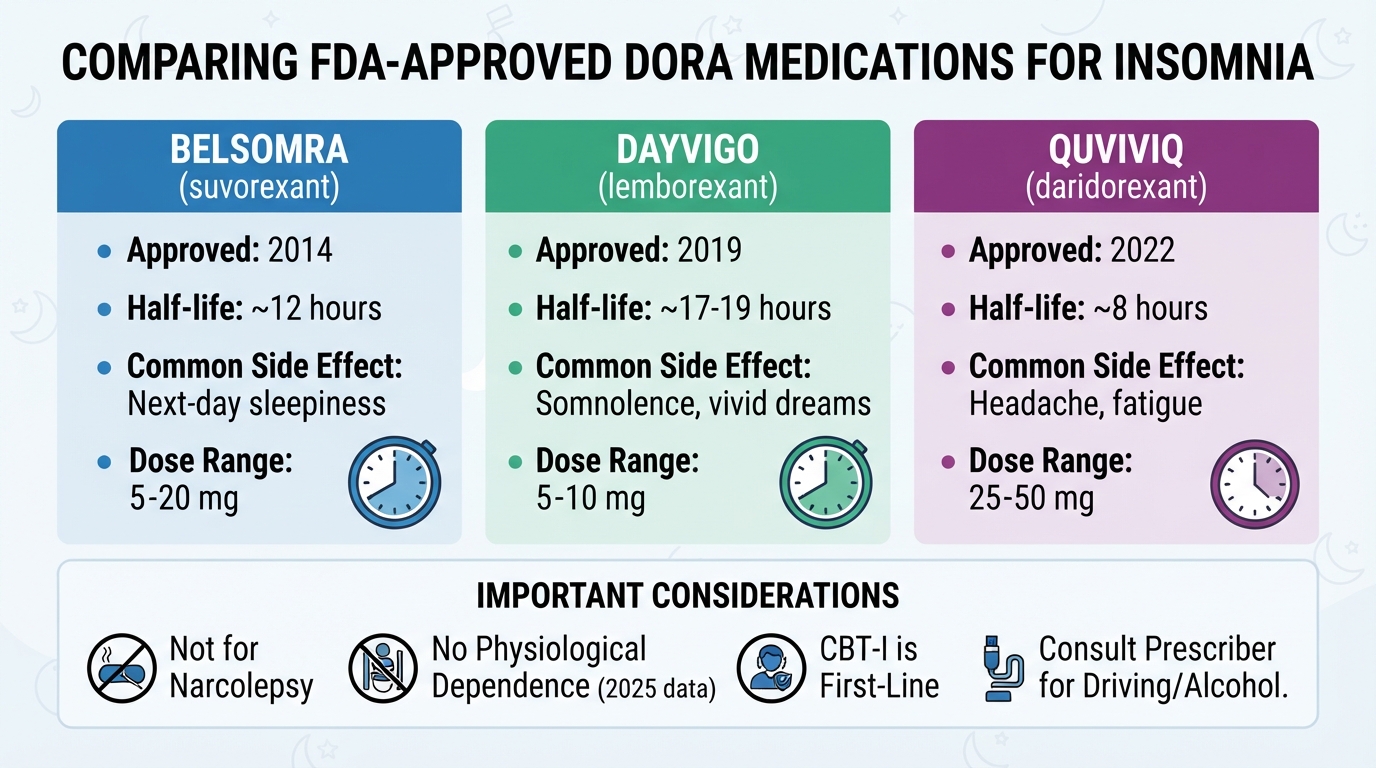
There are no head-to-head trials that settle which is best, so be wary of anyone who ranks them confidently. Here is what the research shows:
- All three beat placebo in network meta-analyses. A 2025 analysis of eight trials with 5,198 adults compared daridorexant, lemborexant, and suvorexant indirectly, and found each has a favorable risk-benefit balance.
- Rankings are indirect. In the 2022 analysis, lemborexant had the highest ranking values on several efficacy measures, but a ranking from indirect comparison is not proof of superiority.
- Side effects are similar in kind. Sleepiness was higher than placebo at the studied higher doses of each drug.
- Practical differences matter, such as how long each lasts in the body, next-day drowsiness, your other medicines, and insurance coverage. Ask your prescriber.
What are the side effects and risks of orexin antagonists?

- Daytime sleepiness and fatigue. A 2024 meta-analysis of 11 trials with 7,703 patients found a higher risk of excessive daytime sleepiness with DORAs than placebo (relative risk 2.15).
- Sleep paralysis. The same analysis found a higher risk (relative risk 3.40). See sleep paralysis.
- Hallucinations. Excessive daytime sleepiness, sleep paralysis, and hallucinations are grouped as narcolepsy-like symptoms.
- Abnormal dreams and nightmares, fatigue, dry mouth, and back pain. These were more frequent than with placebo in a 2022 meta-analysis of suvorexant and lemborexant.
- Next-day impairment. Ask your prescriber about driving and other safety-sensitive tasks.
- Not for people with narcolepsy. Drug labels list this as a contraindication.
Because DORAs make you drowsy, ask about alcohol, other sedatives, and your sleep apnea or lung history before starting. See our complete guide to sleep apnea.
Get urgent help for severe sleepiness where you cannot be woken, trouble breathing, or confusion or hallucinations that frighten you.
Are orexin antagonists addictive?
They have not been linked to physiological dependence, unlike benzodiazepines and Z-drugs. A 2025 meta-analysis notes that the FDA mandated label warnings that benzodiazepines and Z-drugs can lead to physical dependence and induce complex sleep behaviors, while melatonin receptor agonists and DORAs have not been linked to physiological dependence.
That does not make them risk-free. Most trials last weeks to months, so long-term data are limited, and they can cause next-day sleepiness. A 2023 expert guideline sees no need to taper DORAs, but do not stop or change a prescribed medicine on your own. Our guide on how to stop taking sleeping pills covers the general principles for other medicines.
How do orexin antagonists compare with Ambien, benzodiazepines, and trazodone?
They work through a different mechanism. DORAs block a wake-promoting signal, while benzodiazepines and Z-drugs are sedatives that act on GABA receptors. The research does not show that one class is better for everyone. Read about Ambien side effects, benzodiazepines for sleep, and trazodone for sleep. For the big picture, see our guide to sleeping pills and sleep medications.
Wondering whether a medicine is the right tool for your sleep, or what is driving your insomnia in the first place? Book a consultation and we’ll look for the root causes alongside your prescriber.
What should you ask your doctor about orexin antagonists?
- Why a DORA rather than another option, and have I tried CBT-I?
- Which one fits my sleep pattern, health, and insurance?
- How long will I take it, and what is the plan for review and stopping?
- Does it interact with my other medicines, alcohol, or my sleep apnea or lung history?
- Is it safe for me to drive the next day?
- What side effects should I report right away, such as sleep paralysis or hallucinations?
What works better first?
For chronic insomnia, CBT-I is the first-line treatment recommended by the American College of Physicians. It targets the habits and thoughts that keep insomnia going, and it does not carry the side effects of medicine.
What the Research Shows
DORAs beat placebo but cause some side effects. A 2022 systematic review and network meta-analysis in Sleep Medicine Reviews found that DORAs were superior to placebo in all efficacy outcomes except the subjective number of awakenings. They also carried higher risks of somnolence, abnormal dreams, fatigue, and dry mouth. Lemborexant had the three highest ranking values, but the authors concluded that DORAs overall are superior to placebo in efficacy and safety measures.
Dose and timing matter. A 2023 network meta-analysis of 10 randomized trials with 7,806 patients found that the higher doses of lemborexant and suvorexant gave the largest reductions in time awake after sleep onset at one month, about 25 minutes each. The authors concluded that DORAs are more effective than placebo and that dosing may play an important role in managing chronic insomnia.
Narcolepsy-like symptoms are a real, if smaller, concern. A 2024 meta-analysis in the journal Sleep pooled 11 trials with 7,703 patients. DORAs carried a significantly higher risk of excessive daytime sleepiness (relative risk 2.15; 95% confidence interval 1.02 to 4.52) and sleep paralysis (relative risk 3.40; 95% confidence interval 1.18 to 9.80) than placebo.
The newest analysis compares all three indirectly. A 2025 network meta-analysis in Translational Psychiatry included eight trials with 5,198 adults. It noted that DORAs and melatonin receptor agonists have not been linked to physiological dependence, unlike benzodiazepines and Z-drugs, and that a separate network meta-analysis found ramelteon did not improve sleep quality. A sensitivity analysis found that the studied higher doses of each DORA were associated with more somnolence than placebo. Because trials did not compare the three drugs directly, the results cannot declare a winner.
This article is for education only and is not medical advice. Talk with a qualified clinician about your own sleep, health conditions, and medications.
If you would like to see how we might be able to help you with this deeper, schedule a free consult here.
Want a hand building non-drug sleep skills?
Join The Sleep Nirvana Club, our free sleep course and community: Join the free sleep course and community.
When to Seek Professional Help
- Get emergency help for severe sleepiness where you cannot be woken, trouble breathing, or confusion or hallucinations that frighten you.
- You have sleep paralysis, hallucinations, or new episodes of sudden weakness while taking a DORA. Tell your prescriber promptly.
- You feel drowsy the next day or have trouble driving. Do not drive, and tell your prescriber.
- You have trouble sleeping at least three nights a week for three months or more. Ask about CBT-I.
- You feel persistently sad or hopeless, or have thoughts of self-harm. Contact a clinician right away, and in the US you can call or text 988 at any time.
Frequently Asked Questions
What are orexin antagonists for insomnia?
Orexin antagonists, also called dual orexin receptor antagonists (DORAs), are prescription insomnia medicines that block orexin, a brain chemical that promotes wakefulness. Three are FDA-approved: suvorexant (Belsomra), lemborexant (Dayvigo), and daridorexant (Quviviq). Meta-analyses show they beat placebo on most sleep measures, but side effects such as next-day sleepiness and abnormal dreams are common. CBT-I remains the first-line treatment for chronic insomnia.
Are orexin antagonists better than Ambien?
Not clearly. The research does not show that one class is better for everyone. They work differently: DORAs block a wake-promoting signal, while zolpidem is a sedative that acts on GABA receptors. DORAs have not been linked to physiological dependence, whereas Z-drugs carry FDA warnings for dependence and complex sleep behaviors. The right choice depends on your health, other medicines, and risks, so ask your prescriber.
What are the side effects of Belsomra, Dayvigo, and Quviviq?
The most common side effects in trials were daytime sleepiness, abnormal dreams or nightmares, fatigue, and dry mouth. A 2024 meta-analysis found higher risks of excessive daytime sleepiness and sleep paralysis than placebo. Hallucinations are also reported, which is why these drugs are not for people with narcolepsy. Do not drive until you know how a DORA affects you, and tell your prescriber about any unusual symptoms.
Are orexin antagonists addictive?
DORAs have not been linked to physiological dependence, unlike benzodiazepines and Z-drugs, and a 2023 expert guideline sees no need to taper them. That does not make them risk-free: most trials last weeks to months, long-term data are limited, and they can cause next-day sleepiness. Do not stop or change a prescribed medicine on your own, and ask your prescriber how long you should take it.
Which orexin antagonist is best?
No one drug is proven best. Indirect comparisons in network meta-analyses suggest all three beat placebo, and one 2022 analysis ranked lemborexant highest on several efficacy measures, but head-to-head trials are lacking. Doses, timing, how long the effect lasts, side effects, and insurance coverage differ. Choose with your prescriber based on your sleep pattern, health, other medicines, and what you need to do the next day.
When to Work With a Sleep Consultant
We do not prescribe or adjust medicines, and your prescriber should lead any decision about a sleep medicine. What The Sleep Consultant can do is work alongside them. We look for the root causes of your insomnia, such as your circadian rhythm, stress response, hormones, gut, or nutrient status, and help you build the non-drug skills that make good sleep more likely to hold.


