

Gabapentin for sleep is an off-label use of a seizure and nerve-pain medicine, and good evidence for treating insomnia on its own is limited. It is FDA-approved for seizures and postherpetic neuralgia, and it also has guideline support for restless legs syndrome, but it is not approved for insomnia. In 2019 the FDA warned of serious, sometimes fatal breathing problems, especially with opioids or other sedating drugs, lung disease, or older age. Common side effects include dizziness, drowsiness, and unsteadiness, and misuse and withdrawal can occur. Never combine it with alcohol, opioids, or other sedatives without your prescriber’s approval, and do not stop it suddenly. CBT-I is the first-line treatment for chronic insomnia. This is educational information, not medical advice.
Why do doctors prescribe gabapentin for sleep?
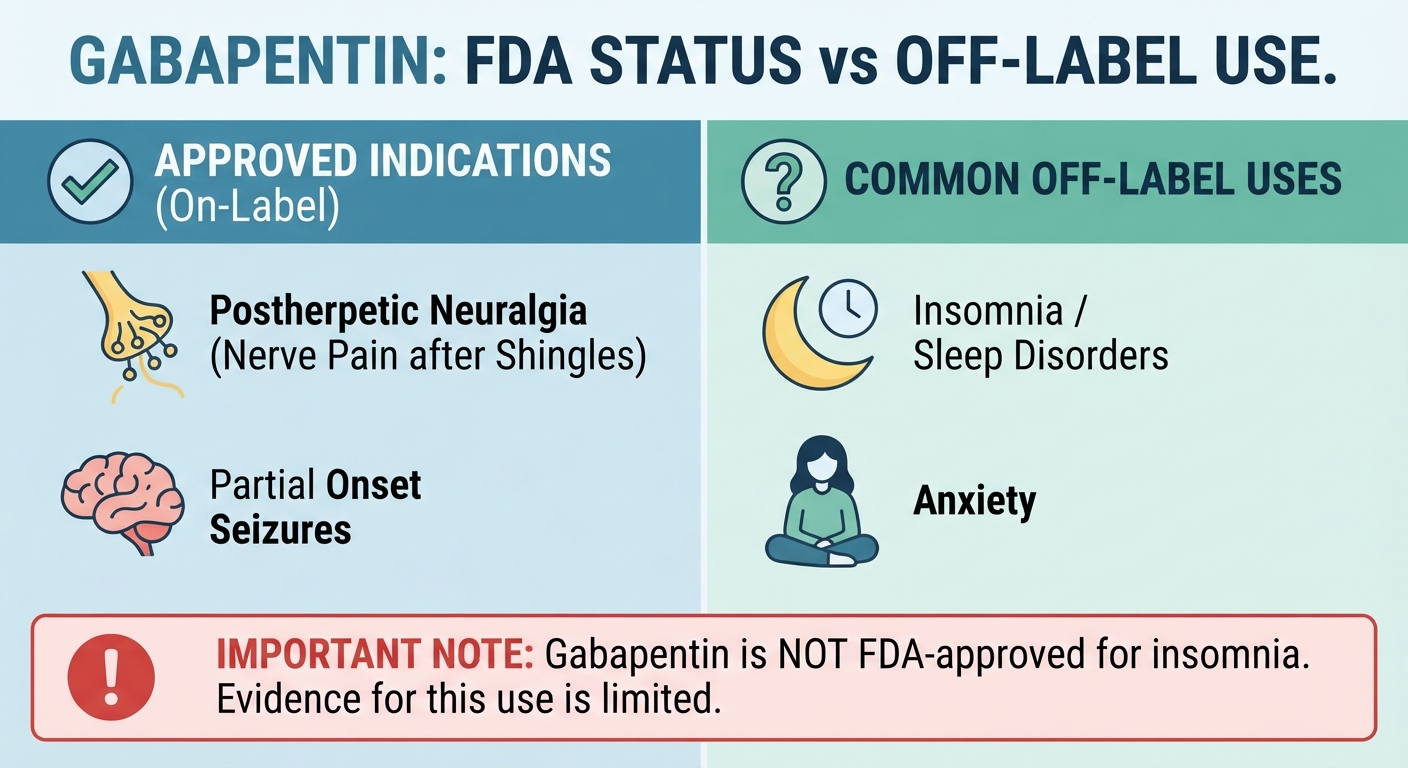
Gabapentin (brand names include Neurontin, Gralise, and Horizant) was approved by the FDA to treat partial seizures and nerve pain after shingles (postherpetic neuralgia). A related form, gabapentin enacarbil (Horizant), is approved for restless legs syndrome.
It can make people drowsy, and it is used off-label for many conditions, including anxiety and insomnia. Off-label means a doctor prescribes it for something the FDA has not approved it for, which is legal and common but means less evidence. Part of the reason doctors reach for it is that it helps some people with pain or restless legs sleep better.
Here is gabapentin for sleep at a glance:
- FDA status: approved for partial seizures and postherpetic neuralgia. Not approved for insomnia.
- Evidence for insomnia: limited. A clinician review called it not the best option for anxiety and insomnia and said better choices exist.
- Guideline support: a 2012 American Academy of Sleep Medicine (AASM) guideline lists gabapentin as an option for moderate to severe restless legs syndrome.
- Safety flags: the FDA’s 2019 breathing warning, misuse, impaired driving, and dizziness.
- Stopping: misuse, dependence, and withdrawal are possible, so do not stop suddenly.
Does gabapentin work for insomnia?
The honest answer is that nobody knows well, and it is not a first choice. Gabapentin has been used off-label in many ways, and there is limited clinical evidence for use outside its licensed indications. A clinician review concluded that gabapentin is not the best option for anxiety and insomnia and that other options would be better choices.
Some people sleep better on it, especially when pain or restless legs were keeping them awake. In that case, the sleep gain comes with treating the underlying problem. For restless legs syndrome specifically, see our guide to restless legs syndrome.

The main concern is that gabapentin may affect breathing during sleep. In one trial the FDA reviewed, gabapentin alone increased pauses in breathing during sleep.
Is gabapentin safe? Risks and side effects
Many people take it without serious problems, but there are real risks.
- Common side effects. In a Cochrane review of gabapentin for neuropathic pain, the most common were dizziness (19%), somnolence (14%), gait disturbance (14%), and swelling in the legs (7%). Weight gain has also been reported. These rates come from pain trials, not insomnia trials.
- Serious breathing problems. On December 19, 2019, the FDA announced that serious, life-threatening, and fatal respiratory depression has been reported with gabapentin and pregabalin. Most cases involved other central nervous system depressants such as opioids, or conditions such as COPD, or older age. Among 49 case reports reviewed over five years, 12 people died, and all had at least one risk factor. There is less evidence of serious breathing problems in healthy people taking gabapentinoids alone.
- Misuse and diversion. Gabapentin has been found in combination with opioids, benzodiazepines, trazodone, zolpidem, and alcohol in postmortem studies. In one cohort of 503 adults who used diverted prescription opioids, 15% said they used gabapentin to get high.
- Impaired driving. Gabapentin has been associated with impaired driving.
- Withdrawal. Prescribers should be aware of the potential for misuse, dependence, and withdrawal.
Get emergency help right away for slowed, shallow, or difficult breathing, extreme sleepiness, unresponsiveness (you cannot wake the person), confusion or disorientation, or unusual dizziness or lightheadedness.
Who should avoid gabapentin for sleep, or ask first?
Talk to your prescriber and pharmacist before taking it for sleep if you:
- Take opioids or other drugs that depress the central nervous system, such as sedatives, sleeping pills, or anti-anxiety medicines. Also mention alcohol.
- Have lung disease such as COPD, or other breathing problems.
- Have sleep apnea. Gabapentin alone increased pauses in breathing during sleep in one trial. See our complete guide to sleep apnea.
- Are an older adult. The FDA notes the elderly are at higher risk of breathing problems.
- Have a history of substance misuse.
- Have kidney problems, since gabapentin is cleared by the kidneys. Tell your prescriber.
- Are pregnant or planning to be.
- Drive or operate machinery, since it can impair driving.
Wondering whether a medicine is really the right tool for your sleep, or what is driving your insomnia in the first place? Book a consultation and we’ll look for the root causes alongside your prescriber.
How does gabapentin compare with other sleep options?
No option is risk-free, and guidelines point to CBT-I first. For the full picture, read our guide to sleeping pills and sleep medications. For a closer look at another off-label choice, see trazodone for sleep.
If your insomnia comes with pain, restless legs, or hot flashes, ask your doctor whether treating that problem directly helps your sleep. That is a different question from taking gabapentin as a sleeping pill.
Can you stop gabapentin suddenly?
No. Do not stop it suddenly without talking with your prescriber. Prescribers are advised to be aware of the potential for misuse, dependence, and withdrawal. A prescriber can set a gradual plan. Our guide on how to stop taking sleeping pillscovers general principles, though it focuses on other medicines, so ask your prescriber about your own plan.
What should you ask your doctor about gabapentin for sleep?
- Why gabapentin rather than another option, and what problem is it meant to treat?
- Have I tried CBT-I, or can you refer me?
- Do my other medicines, alcohol use, or lung or sleep apnea history raise my breathing risk?
- What side effects should I watch for, and when should I get urgent help?
- Is it safe to drive?
- How long will I take it, and what is the plan for stopping?
What works better first?
For chronic insomnia, CBT-I is the first-line treatment recommended by the American College of Physicians. Read about CBT-I. Also ask about other things that disturb sleep, such as pain, restless legs, hot flashes, side effects from other drugs, and sleep apnea.
What the Research Shows
Evidence for insomnia is limited. A clinician review of gabapentin’s use found that it is widely used off-label for anxiety and insomnia but is not the best option, and that better choices exist. Providers should be aware of the limited clinical evidence for use outside licensed indications and of potential misuse. A review of gabapentin’s history notes that after its approval for seizures it was promoted for off-label uses, especially pain, despite underwhelming evidence.
The FDA issued a breathing warning in 2019. The FDA announced that serious, life-threatening, and fatal respiratory depression has been reported with gabapentin and pregabalin, mostly in people with respiratory risk factors such as opioid use, other central nervous system depressants, COPD, or older age. Among 49 case reports from 2012 to 2017, 12 people died from respiratory depression, all with at least one risk factor. One trial found that gabapentin alone increased pauses in breathing during sleep. The FDA required new label warnings and trials of abuse potential. A separate study found that gabapentinoid use was associated with increased risk of severe COPD exacerbation (hazard ratio 1.39).
Misuse and co-use are real concerns. In postmortem studies, gabapentin has been detected with opioids, benzodiazepines, trazodone, zolpidem, stimulants, cannabinoids, and alcohol. In a cohort of 503 adults who used diverted prescription opioids, 15% identified using gabapentin to get high. In 2016 data, 14% to 19% of patient visits involving gabapentin or pregabalin also involved opioids.
Where it does have guideline support: restless legs syndrome. The 2012 AASM guideline on restless legs syndrome and periodic limb movement disorder recommended gabapentin as an option for treating moderate to severe restless legs syndrome. That is a different condition from insomnia.
This article is for education only and is not medical advice. Talk with a qualified clinician about your own sleep, health conditions, and medications.
If you would like to see how we might be able to help you with this deeper, schedule a free consult here.
Want a hand building non-drug sleep skills?
Join The Sleep Nirvana Club, our free sleep course and community: Join the free sleep course and community.
When to Seek Professional Help
- Get emergency help for slowed, shallow, or difficult breathing, extreme sleepiness, confusion, unusual dizziness, or if you cannot wake someone who took gabapentin.
- You take gabapentin with opioids, sedatives, sleeping pills, or alcohol. Call your prescriber or pharmacist now.
- You want to stop, change the amount, or feel unwell after missing a dose. Do not stop suddenly. Talk with your prescriber.
- You have trouble sleeping at least three nights a week for three months or more. Ask about CBT-I.
- You feel persistently sad or hopeless, or have thoughts of self-harm. Contact a clinician right away, and in the US you can call or text 988 at any time.
Frequently Asked Questions

Is gabapentin good for sleep?
It may help some people sleep, but evidence for treating insomnia on its own is limited, and gabapentin is not FDA-approved for insomnia. It is approved for seizures and postherpetic neuralgia, and it has guideline support for restless legs syndrome. A clinician review concluded it is not the best option for insomnia and that better choices exist. CBT-I is the first-line treatment for chronic insomnia. If you are prescribed gabapentin for another reason, better sleep may be a bonus.
Is gabapentin safe to take every night?
Not necessarily. Gabapentin carries an FDA warning about serious, sometimes fatal breathing problems, mainly in people who also take opioids or other sedating drugs, have lung disease such as COPD, or are older. Common side effects include dizziness, drowsiness, and unsteadiness. Misuse, dependence, and withdrawal can occur. If your doctor prescribes it, ask about your breathing risk, other medicines, and a plan for review. Do not drive until you know how it affects you.
What are the side effects of gabapentin?
Common side effects include dizziness, drowsiness, unsteady walking, and swelling in the legs. Weight gain has also been reported. Serious problems need urgent care: confusion, unusual dizziness, extreme sleepiness, slowed or shallow breathing, or being hard to wake. Gabapentin can impair driving. Misuse is possible, especially with other sedatives or opioids. Tell your prescriber about any side effects, and do not stop suddenly on your own.
Can you take gabapentin with alcohol or other sleep medicines?
This is risky. The FDA warns that gabapentin can cause serious breathing problems, especially when combined with opioids or other drugs that depress the central nervous system. Alcohol, sleeping pills, anti-anxiety medicines, and sedating antihistamines can add to sedation. Always tell your prescriber and pharmacist about everything you take, including alcohol and over-the-counter products. Seek emergency help for slowed or difficult breathing, extreme sleepiness, or being unable to wake the person.
Can you stop gabapentin suddenly?
Do not stop gabapentin suddenly without talking to your prescriber. Prescribers are told to be aware of the potential for misuse, dependence, and withdrawal, and stopping abruptly can cause problems, including a return of seizures in people who take it for epilepsy. A prescriber can set a gradual plan. CBT-I can help you sleep without medicine while you taper. Our guide on stopping sleeping pills covers general principles, but ask your prescriber about your own plan.
When to Work With a Sleep Consultant
We do not prescribe or adjust medicines, and your prescriber should lead any decision about gabapentin. What The Sleep Consultant can do is work alongside them. We look for the root causes of your insomnia, such as your circadian rhythm, stress response, pain, hormones, gut, or nutrient status, and help you build the non-drug skills that make sleep more likely to hold.


