

Lavender for sleep has modest support in small studies, but major health sources say it is unclear whether lavender aromatherapy helps sleep quality or insomnia. A 2025 meta-analysis of lavender essential oil found better sleep quality (standardized mean difference −0.56), but the authors said study quality limits confidence. Oral lavender oil capsules (Silexan) reduced anxiety in trials, and two trials also found better sleep quality. Inhaled lavender is possibly safe but can cause headache or coughing, topical lavender can cause skin allergy, and oral lavender should be discussed with a clinician. Be cautious with topical lavender products on children, and ask first if you are pregnant or take sedatives. CBT-I is the first-line treatment for chronic insomnia. This is educational information, not medical advice.
Why do people use lavender for sleep?
Lavender (Lavandula angustifolia) is a fragrant herb used for centuries to promote calm. It is promoted for anxiety, stress, and sleep in several forms. The research differs by form:
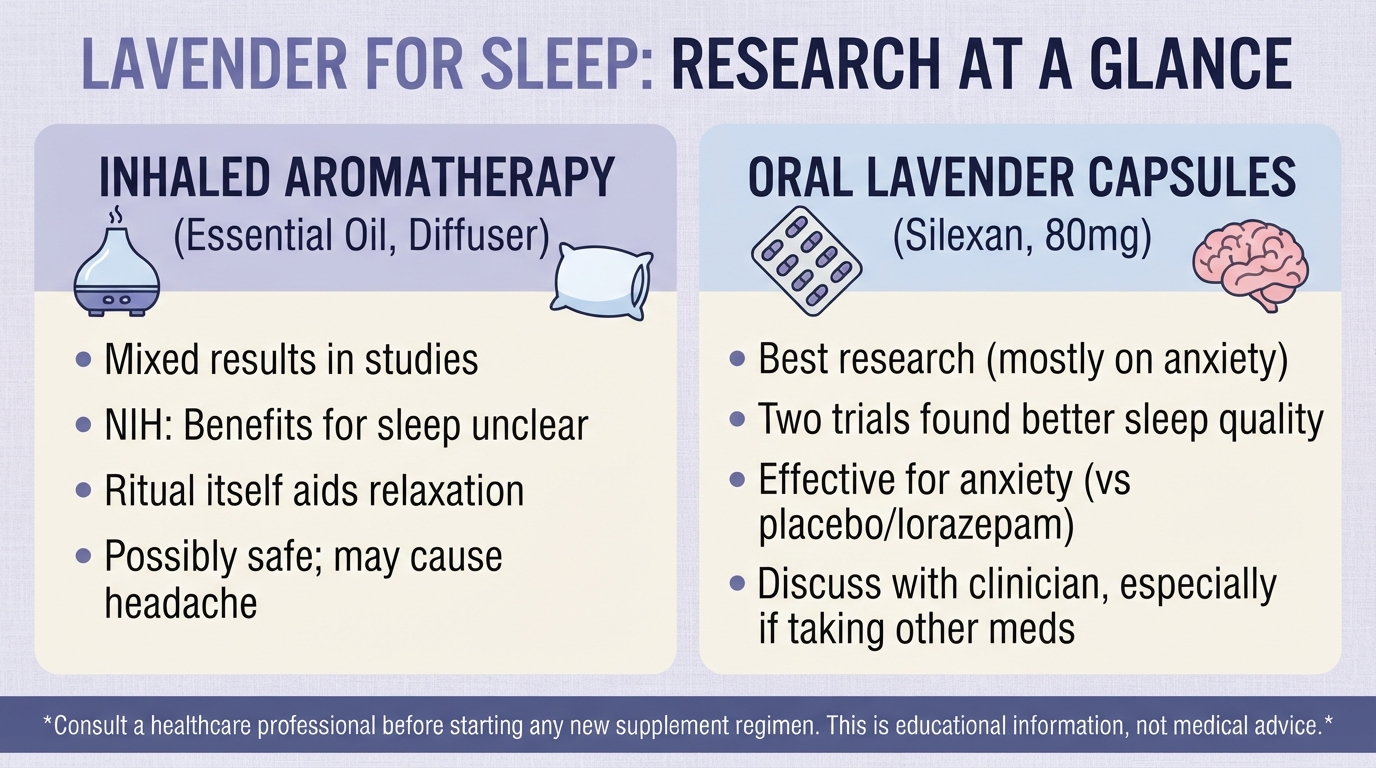
- Inhaled aromatherapy (essential oil, diffuser, pillow spray): mixed results, and the NIH says benefits for sleep are unclear.
- Oral lavender oil capsules (Silexan): the best research, mostly on anxiety. Two trials reported better sleep quality.
- Topical or massage use: may cause allergic skin reactions in some people.
- Lavender tea or capsules for mood: small, preliminary studies suggest they might reduce symptoms of depression in some people. The research on sleep is much thinner.
Does lavender help you sleep?
Possibly, a little. The pooled results look positive, but the studies are small and varied, so the honest answer is “maybe.”
- A 2025 meta-analysis of lavender essential oil in adults found a significant sleep-enhancing effect (standardized mean difference −0.56; 95% confidence interval −0.96 to −0.17). The authors said the quantity and quality of the included studies mean this needs confirming in higher-quality studies.
- A 2021 meta-analysis of aromatherapy found that aromatherapy, including lavender oil, improved sleep quality and reduced stress, pain, anxiety, depression, and fatigue in adults and older adults.
- The NIH’s National Center for Complementary and Integrative Health says it is unclear whether aromatherapy with lavender oil has benefits for anxiety, stress, depression symptoms, some types of pain, sleep quality, or insomnia. It adds that some people report an improved sense of quality of life.
Part of the benefit may be the ritual itself. A calming scent, a dim room, and a wind-down routine can all help you relax. That is useful, but it is not proof that lavender works on sleep by itself.
Oral lavender (Silexan) vs aromatherapy: which is better?
We do not know, and no study has compared them for sleep. A 2018 systematic review searched the literature and found no evidence comparing oral Silexan with inhaled lavender aromatherapy for sleep latency, sleep duration, sleep quality, disturbed sleep, or anxiety.
What we do know about Silexan, a standardized oral lavender oil capsule preparation:
- Anxiety: a meta-analysis found that oral Silexan 80 mg per day for at least 6 weeks reduced anxiety on the Hamilton Anxiety Scale (mean difference −2.90; 1,173 participants). It concluded that oral lavender essential oil appears effective for anxiety, while inhalation showed only an indication of an effect of reasonable size because the studies varied.
- Sleep quality: two trials by Kasper and colleagues in 2010 and 2015, using an 80 mg capsule, reported significant improvements in sleep quality (Pittsburgh Sleep Quality Index) and anxiety compared with placebo.
- Against a drug: a 2010 randomized, double-blind study of 77 adults with generalized anxiety disorder found Silexan about as effective as lorazepam for anxiety. That study was about anxiety, not sleep.
- A small open-label trial of 47 people reported fewer and shorter night-time awakenings after 6 weeks. Open-label means there was no placebo group.
Silexan is a specific product, so other lavender supplements may differ. Ask a clinician before using one, especially if you take other medicines.
Is lavender safe?
For most people, aromatherapy is low risk, but there are cautions. The NIH says:
- Aromatherapy with lavender oil is considered possibly safe, but it may cause headache or coughing.
- Topical products containing lavender may cause allergic skin reactions in some people.
- Children: a few cases of swelling of breast tissue have been reported in children who used topical products containing lavender. It is unclear whether the lavender was responsible, since the condition has many causes. Be cautious with topical lavender on children.
Also keep these general precautions in mind:
- Do not swallow essential oils. Oral use is for standardized oral products only, and a clinician should be involved.
- Ask a clinician first if you are pregnant or breastfeeding, or take sedatives or anti-anxiety medicines.
- Keep oils away from children and pets, and ventilate the room.
How could you try lavender for sleep? A simple plan

Treat this as an experiment with low-risk options first:
- Start with aromatherapy, the simplest and lowest-commitment form.
- Use it sparingly. Follow the product directions, and avoid heavy fragrance in a closed room.
- Do a skin patch test before using any topical product.
- Pair it with the basics: dim lights, no screens, a steady schedule. See our guide to supplements for sleep for the bigger picture.
- Track for two weeks. Note how long it takes to fall asleep and how you feel in the morning.
- Stop if you notice headache, coughing, a rash, or breathing symptoms.
- If you are curious about an oral product, talk with a clinician or pharmacist first.
- If nothing changes, move on. Do not keep stacking products. Compare other options, such as chamomile tea, glycine, and valerian root.
Using a few calming habits and still not sleeping? That can point to deeper causes behind the scenes, like a stress response that stays switched on. If that sounds like you, book a consultation and we’ll look for the root cause.
Can lavender help with anxiety at night?
The evidence for anxiety is stronger than the evidence for sleep, especially for oral Silexan. A meta-analysis found that oral lavender oil appears effective for anxiety, and that inhaled lavender showed an indication of an effect of reasonable size, though the studies varied a lot.
If worry is what keeps you awake, therapies with better evidence for sleep may help more. See anxiety and insomnia.
What works better first?
For chronic insomnia, CBT-I is the first-line treatment recommended by the American College of Physicians. Lavender is an optional extra, not a substitute. Read about CBT-I.
What the Research Shows
A recent meta-analysis found a moderate effect, with caveats. A 2025 systematic review and meta-analysis in Holistic Nursing Practice found that lavender essential oil intervention in adults had a significant sleep-enhancing effect (standardized mean difference −0.56, 95% confidence interval −0.96 to −0.17, P = .005). The authors concluded that lavender essential oil can enhance sleep quality in adults, but that the conclusion needs verification in higher-quality studies because of the quantity and quality of the included studies.
A broader review of aromatherapy is positive too. A 2021 meta-analysis in Complementary Therapies in Medicine concluded that aromatherapy improves sleep quality and reduces stress, pain, anxiety, depression, and fatigue in adults and older adults. Aromatherapy is a broad category, and not all of it is lavender.
The NIH is more cautious. The National Center for Complementary and Integrative Health says it is unclear whether aromatherapy with lavender oil has benefits for sleep quality or insomnia, although some people report an improved sense of quality of life. It describes aromatherapy as possibly safe, with headache or coughing as possible effects.
The oral capsule research centers on anxiety. A 2019 meta-analysis in Phytomedicine found a significant anxiety reduction with oral Silexan 80 mg per day for at least six weeks (Hamilton Anxiety Scale mean difference −2.90). A 2020 review of oral plant extracts for sleep noted two trials by Kasper and colleagues with significant improvements in sleep quality and anxiety compared with placebo, a 2010 study of 77 adults in which Silexan was as effective as lorazepam for generalized anxiety, and an open-label trial of 47 participants that reported fewer night-time awakenings.
This article is for education only and is not medical advice. Talk with a qualified clinician about your own sleep, health conditions, and medications.
If you would like to see how we might be able to help you with this deeper, schedule a free consult here.
Want a hand building a calmer evening routine?
Join The Sleep Nirvana Club, our free sleep course and community: Join the free sleep course and community.

When to Seek Professional Help
- You have trouble sleeping at least three nights a week for three months or more. Ask about CBT-I, the first-line treatment for chronic insomnia.
- You develop a rash, headache, coughing, or breathing symptoms after using lavender. Stop it, and get urgent care for any trouble breathing.
- You are pregnant or breastfeeding, or take sedatives or other medicines, and want to use an oral lavender product. Ask a clinician or pharmacist first.
- Your anxiety is constant or severe, or you feel persistently sad or hopeless, or have thoughts of self-harm. Contact a clinician right away, and in the US you can call or text 988 at any time.
- You snore loudly, gasp at night, or feel very sleepy by day. These can signal sleep apnea.
Frequently Asked Questions
Does lavender help you sleep?
It may help a little, but the evidence is unclear. A 2025 meta-analysis found that lavender essential oil improved adult sleep quality, but the authors said study quality limits confidence. The National Center for Complementary and Integrative Health says it is unclear whether lavender aromatherapy helps sleep quality or insomnia, although some people report feeling better. Treat lavender as a low-risk relaxation aid, not a treatment for insomnia.
Is lavender oil safe to use at night?
Aromatherapy with lavender oil is considered possibly safe, but it may cause headache or coughing. Topical products can cause allergic skin reactions, and a few cases of breast swelling have been reported in children who used topical lavender products, though the cause is unclear. Do not swallow essential oils, keep them away from children and pets, and ask a clinician first if you are pregnant or take sedatives.
What is Silexan, and does it help sleep?
Silexan is a standardized oral lavender oil capsule product. Trials found it reduced anxiety, and two trials using an 80 mg capsule reported better sleep quality scores than placebo. Most of its research is about anxiety, not insomnia, and it is a specific product, so other lavender supplements may differ. Ask a clinician before using it, especially if you take other medicines.
Does lavender work better as a pill or as aromatherapy?
We do not know, because no studies compared oral lavender capsules with inhaled lavender aromatherapy for sleep. Oral Silexan has the stronger research for anxiety, including a meta-analysis showing less anxiety after at least six weeks. Aromatherapy has mixed research and an unclear effect on sleep, but it is low cost and low risk for many people. If you want to try one, aromatherapy is the simpler starting point.
Can lavender help anxiety at night?
It may. A meta-analysis found oral lavender oil (Silexan) reduced anxiety, and inhaled lavender showed an indication of an effect of reasonable size, though the studies varied a lot. Anxiety evidence is stronger than sleep evidence. If worry is what keeps you up, CBT-I and anxiety treatment have better support. See a clinician if anxiety is constant or severe.
When to Work With a Sleep Consultant
If you have tried lavender and other calming habits and still sleep poorly, a deeper cause may be involved: your circadian rhythm, stress response, hormones, gut, or nutrient status. The Sleep Consultant looks for those root causes instead of handing you another product.


