

Doctors diagnose narcolepsy with two tests in sequence: an overnight sleep study (polysomnography) followed the next day by the Multiple Sleep Latency Test (MSLT). The MSLT measures how fast you fall asleep during daytime naps and whether you drop into REM sleep within 15 minutes. A mean sleep latency of 8 minutes or less and two or more of those early REM periods point to narcolepsy. Many other conditions cause heavy daytime sleepiness, and sleep apnea and insufficient sleep top the list, so the overnight study also rules them out. Heavy sleepiness is a reason to see a doctor, not to self-diagnose. This is educational information, not medical advice.
Short answer (40-60 words): Narcolepsy testing uses an overnight sleep study followed by the MSLT, a series of daytime naps. Doctors look for falling asleep in 8 minutes or less on average and REM sleep within 15 minutes of sleep onset in at least two naps. The night study rules out sleep apnea and other causes of sleepiness.
What Counts as Excessive Daytime Sleepiness?
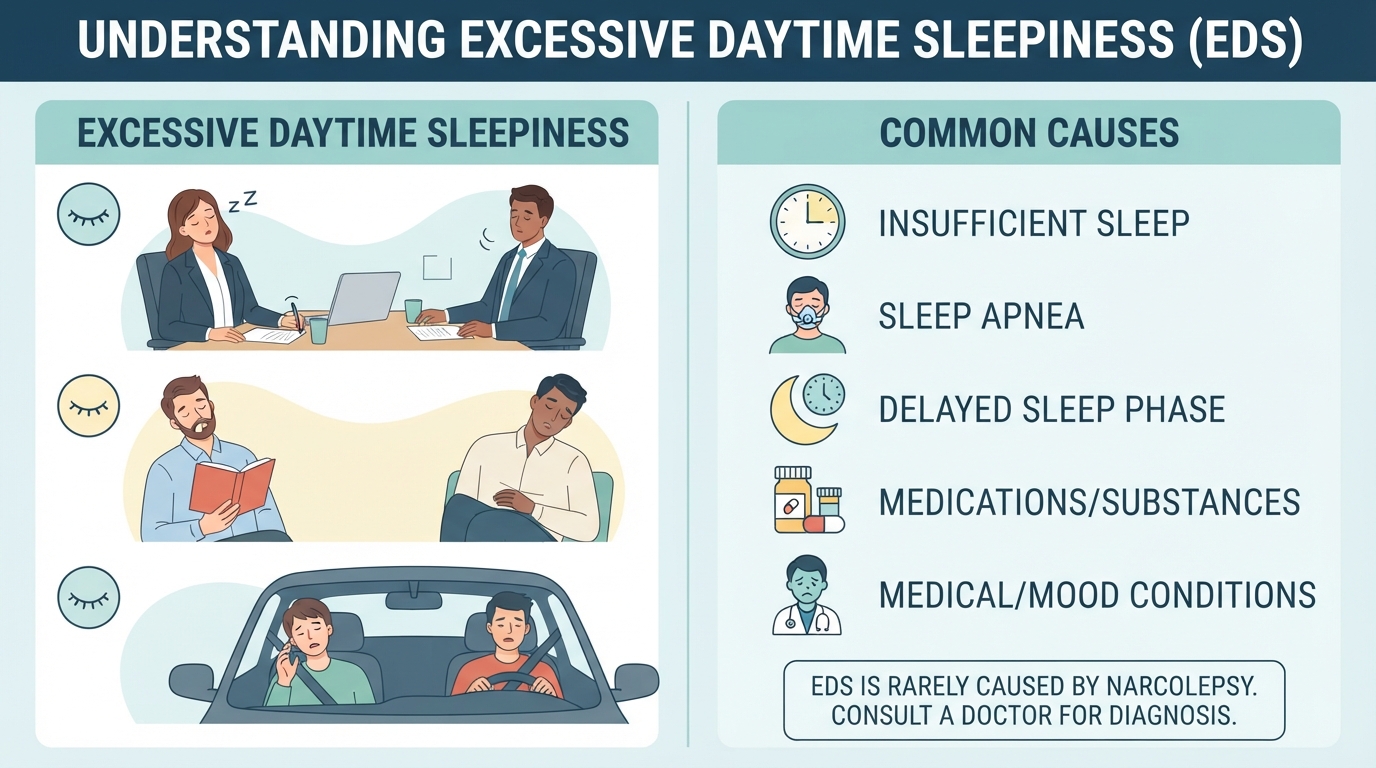
Excessive daytime sleepiness (EDS) means you struggle to stay awake during the day, even after what should be enough sleep. You may doze off in meetings, while reading, or when you are a passenger in a car. It differs from fatigue, where you feel worn out but cannot nap. Our guide on being tired after eight hours of sleep covers that difference.
Doctors often start with the Epworth Sleepiness Scale, a short questionnaire, then decide which tests to order. Drowsy driving is a real safety risk, so treat heavy sleepiness seriously.
What Else Causes Daytime Sleepiness?
Narcolepsy is one of the rarer causes. These are more common:
- Insufficient sleep. Many people simply do not get enough hours.
- Sleep apnea. Breathing interruptions fragment sleep and cause strong daytime sleepiness. See insomnia or sleep apnea.
- Delayed sleep phase. A late body clock can leave you short on sleep on workdays.
- Medications and substances. Sedatives and withdrawal from stimulants both play a role.
- Medical and mood conditions. Depression, thyroid problems, and anemia can all cause sleepiness.
The diagnostic criteria for narcolepsy explicitly require that sleepiness not be better explained by insufficient sleep, obstructive sleep apnea, delayed sleep phase disorder, or the effects of medications or substances. That rule is why the overnight study matters.
How Do Doctors Test for Narcolepsy?

Step 1: Overnight sleep study (polysomnography)
You sleep in a lab the night before the MSLT. The study should record at least 6 hours of sleep, and it rules out sleep apnea and other disorders that could explain your sleepiness. It also checks how soon you reach REM sleep. Our overnight sleep study guide walks you through the night. Many labs also ask for a sleep diary or wrist actigraphy for a week or two beforehand.
Step 2: The Multiple Sleep Latency Test (MSLT)

The next day, you take a series of nap opportunities spaced through the day. Technologists record how long you take to fall asleep and whether REM sleep begins within 15 minutes of sleep onset. They call that a sleep-onset REM period, or SOREMP. The test uses at least four naps.
Narcolepsy criteria call for:
- A mean sleep latency of 8 minutes or less across the naps
- Two or more SOREMPs
A SOREMP on the night-before study, within 15 minutes of sleep onset, can replace one of the SOREMPs on the MSLT. Doctors cannot use the MSLT alone to confirm or rule out narcolepsy, which is why the overnight study comes first.
Step 3: Spinal fluid hypocretin test (sometimes)
Narcolepsy type 1 involves loss of hypocretin, a brain chemical that promotes wakefulness. A lumbar puncture can measure hypocretin-1 in spinal fluid. A level of 110 pg/mL or lower, or less than one third of normal values, meets the criteria for type 1. Doctors use this test mostly when the picture is unclear.
At a Glance: The Two Main Types
| Feature | Narcolepsy Type 1 | Narcolepsy Type 2 |
|---|---|---|
| Daily sleepiness for at least 3 months | Yes | Yes |
| Cataplexy (sudden muscle weakness with emotion) | Present | Absent |
| MSLT (8 minutes or less, 2+ SOREMPs) | Positive, or low hypocretin instead | Positive |
| Spinal fluid hypocretin | Low (110 pg/mL or lower) | Not measured, or normal |
How Do You Prepare for the MSLT?
Follow your lab’s instructions first. Common requirements include:
- Sleep enough. The MSLT assumes a night of at least 6 hours of sleep. Keep a regular schedule beforehand.
- Stop interfering medications. Guidance says to discontinue stimulants and sedative-hypnotics about two weeks before testing. Never stop a prescription on your own. Ask your prescriber to supervise any change.
- Avoid caffeine and alcohol as your lab instructs.
- Tell staff about everything you take, including antidepressants and supplements.
How Reliable Is the MSLT?
Not perfect. The test can show a false positive. One report found that meeting the narcolepsy numbers occurs in about 6 percent of men without narcolepsy, and sleep deprivation, sleep apnea, and shift work can produce the same result. The test can also miss narcolepsy. One source reported false negatives in 7 to 20 percent of tests, driven by factors such as medications. If doctors strongly suspect type 1 narcolepsy but the MSLT does not meet criteria, repeating the test is a recognized strategy.
Sleep paralysis and hallucinations at sleep onset affect about two thirds of people with narcolepsy, but they also occur in people without it. They do not diagnose narcolepsy by themselves.
When Should You See a Doctor?
See a doctor if you fall asleep at unplanned times, struggle to stay awake while driving, have sudden muscle weakness when you laugh or feel strong emotion, or feel very sleepy despite getting enough sleep. A sleep medicine physician can order the right tests. Read our guide on who to see first, and bring a sleep diary using our consultation checklist.
Not sure whether your sleepiness points to a medical problem? Book a consultation with The Sleep Consultant. We cannot diagnose or test for narcolepsy, and we will help you prepare for a medical visit and tell you when to see a doctor first.
What the Research Shows
Diagnosis uses an overnight study plus the MSLT. ICSD-3 criteria require a mean sleep latency of 8 minutes or less and two or more SOREMPs, with a SOREMP on the night study able to replace one.
The night study rules out other causes. It documents at least 6 hours of sleep and screens for sleep apnea, which is a far more common cause of daytime sleepiness.
Hypocretin testing offers an alternative path. A spinal fluid hypocretin-1 level of 110 pg/mL or lower meets the criteria for narcolepsy type 1.
The MSLT has limits. It can produce false positives and false negatives, and doctors cannot use it alone to confirm or rule out narcolepsy.
This article is for educational purposes only and is not a substitute for personalized medical advice, diagnosis, or treatment.
If you would like to see how we might be able to help you with this deeper, schedule a free consult here.
Want a Free Starting Point?
Join the free sleep course and community: Join the Sleep Nirvana Club
When to Seek Professional Help
- You fall asleep at unplanned times, including at work or at the wheel
- You have sudden muscle weakness with laughter or strong emotion
- You feel very sleepy every day for three months or longer
- You snore loudly, gasp, or a partner sees you stop breathing
- You take a stimulant or sedative and want to change it before testing
Frequently Asked Questions
How do doctors test for narcolepsy?
Doctors use an overnight sleep study followed by the Multiple Sleep Latency Test the next day. The MSLT measures how fast you fall asleep during daytime naps and whether REM sleep starts within 15 minutes. A spinal fluid hypocretin test is sometimes used too.
What does the MSLT measure?
It measures how quickly you fall asleep during several daytime nap opportunities and how often you enter REM sleep within 15 minutes of falling asleep. Narcolepsy criteria call for a mean sleep latency of 8 minutes or less and two or more of those early REM periods.
Why do I need a sleep study the night before the MSLT?
The overnight study confirms you slept at least 6 hours and rules out sleep apnea and other conditions that can mimic narcolepsy. It also records early REM sleep, which can count toward the diagnosis. Doctors cannot use the MSLT alone.
Do I need to stop my medications before an MSLT?
Guidance says doctors usually stop stimulants and sedative-hypnotics about two weeks beforehand because they change test results. Never stop a prescription on your own. Your prescriber or sleep doctor will tell you what to do.
Can the MSLT be wrong?
Yes. It can show a false positive, especially after sleep deprivation or in sleep apnea, and it can miss narcolepsy in some people. Doctors interpret it alongside your history and the night study, and they can repeat it.
When to Work With a Sleep Consultant
Heavy daytime sleepiness needs a medical workup first. If you want help getting ready for those visits and building habits that support your energy, we can help.


