

If you cannot tolerate CPAP, the main alternatives are a custom oral appliance, positional therapy, the Inspire implant, weight loss, and surgery. Oral appliances work best for mild to moderate sleep apnea, and the American Academy of Sleep Medicine (AASM) and the American Academy of Dental Sleep Medicine recognize them as an option for people who cannot use CPAP. CPAP remains the stronger treatment for severe apnea. Positional therapy suits people whose apnea mostly happens on their back. Inspire fits some people with moderate to severe apnea who fail CPAP. Do not stop CPAP on your own. Talk to your sleep doctor, and confirm any new treatment works with a follow-up sleep test. This is educational information, not medical advice.
Short answer (40-60 words): The main CPAP alternatives are custom oral appliances for mild to moderate apnea, positional therapy for back-sleeping apnea, the Inspire implant for some moderate to severe cases, weight loss, and surgery. CPAP stays stronger for severe apnea. Always get a follow-up sleep test to confirm any alternative works.
First, Can You Fix the CPAP Problem?
Many people quit CPAP over fixable issues: mask fit, dry air, pressure discomfort, claustrophobia, or trouble sleeping with the mask. Ask your sleep clinic about a different mask, humidification, or a desensitization plan. If insomnia contributes, CBT-I can help. A randomized trial found that adding CBT-I to CPAP improved both CPAP use and insomnia symptoms more than CPAP alone. See our guide on insomnia and sleep apnea together.
CPAP Alternatives Compared
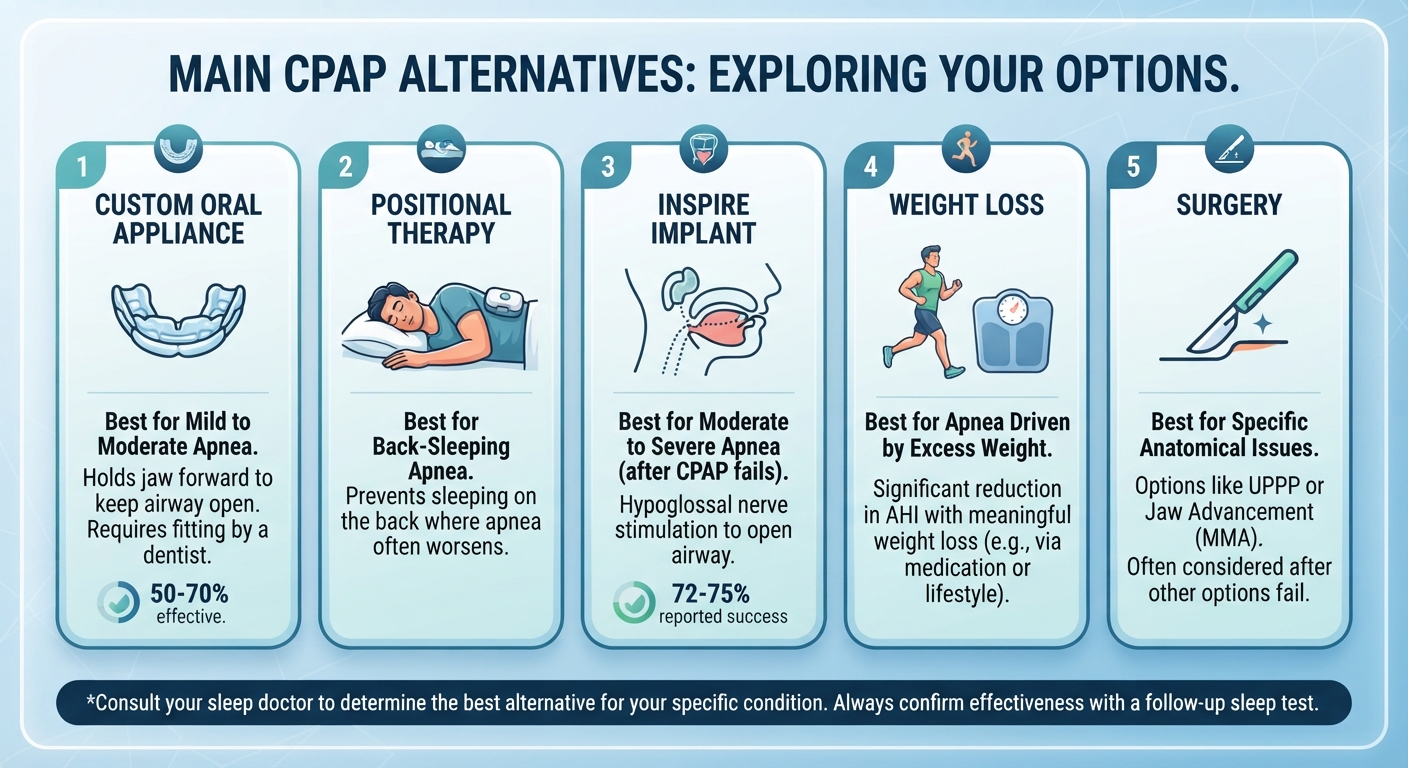
| Option | Best For | What the Evidence Says | Main Trade-Off |
|---|---|---|---|
| Custom oral appliance (mandibular advancement device) | Mild to moderate apnea, or CPAP intolerance | Similar average benefit to CPAP in mild to moderate apnea; works for roughly 50 to 70 percent of people | Less effective than CPAP for severe apnea; jaw and tooth side effects |
| Positional therapy | Apnea mostly on your back | Meta-analysis found no significant difference from CPAP or oral appliances, with very wide variation between studies | Works only for the positional type; weight gain can change that |
| Inspire (hypoglossal nerve stimulation) | Moderate to severe apnea after CPAP fails | Reported success around 72 to 75 percent in appropriate candidates | Surgery; strict candidacy rules |
| Weight loss, including medication | Apnea driven by excess weight | Tirzepatide cut apnea severity by about 55 percent in a major trial | Cost; ongoing medical management |
| Surgery (UPPP, jaw advancement, nasal) | Specific anatomy, usually after other options fail | Variable; jaw advancement strong with the right anatomy, UPPP helps fewer than half meaningfully | Invasive; results depend on your anatomy |
Oral Appliances
A custom mandibular advancement device holds your lower jaw forward to keep your airway open. A dentist trained in dental sleep medicine fits it. In mild to moderate apnea, oral appliances show similar average benefit to CPAP in several reviews, largely because people wear them more consistently. The American Sleep Apnea Association reports about 90 percent adherence with oral appliances compared with about 50 percent for CPAP.
Know the limits. Oral appliances work for about 50 to 70 percent of people, and one study found a 58 percent success rate. One review found CPAP brought the apnea-hypopnea index (AHI) below 5 in 76 percent of mild cases versus 62 percent for oral appliances. Side effects include jaw pain and tooth movement, and pushing the jaw forward too far can even worsen apnea. Sources disagree on satisfaction: some say people prefer oral appliances, while one European review reports lower patient and partner satisfaction than with CPAP.
Insurers often cover oral appliances only after CPAP fails. A follow-up sleep test with the appliance in place confirms that it works. Our mouthguard and snoring guide explains why a store-bought guard does not equal a custom device.
Positional Therapy

If your apnea happens mostly when you sleep on your back, devices that keep you on your side can help. A 2025 meta-analysis found no significant difference in AHI between positional therapy and CPAP, or between positional therapy and oral appliances. Treat that result with caution, because the studies varied enormously, with heterogeneity as high as 99 percent in some comparisons. Weight gain can also turn positional apnea into non-positional apnea, so reassess if your weight changes.
The Inspire Implant
Inspire stimulates the nerve that moves your tongue to keep the airway open. It suits some people with moderate to severe apnea who cannot use CPAP, and candidacy depends on your airway collapse pattern. Read the full details in our Inspire implant guide.
Weight Loss and Medication
When excess weight drives your apnea, losing weight can reduce its severity. The SURMOUNT-OSA trial found tirzepatide cut apnea severity by about 55 percent in one trial arm. See our Ozempic and sleep apnea article. Medication works best as part of a plan with your doctor, and some people still need airway therapy.
Surgery and Other Options
Surgery has a narrower role. Jaw advancement surgery can work well for the right jaw anatomy. Soft palate surgery (UPPP) helps fewer than half of people meaningfully at one year, according to one 2026 comparison guide. Nasal surgery rarely cures apnea alone but can make CPAP or an oral appliance easier to tolerate. Myofunctional therapy, which trains the tongue and throat muscles, shows modest benefit and works best as an add-on.
How to Choose

- Confirm your severity with a sleep study. See our home test vs. lab study guide.
- Troubleshoot CPAP first with your sleep clinic.
- Match the option to your severity and anatomy. Mild to moderate apnea suits oral appliances. Back-sleeping apnea suits positional therapy. Moderate to severe apnea after CPAP failure may suit Inspire.
- Retest. Any alternative needs a follow-up sleep test to prove it works.
- Do not go untreated. Moderate and severe apnea carries health risks, so switch under medical supervision.
Want help working out what to ask your sleep doctor? Book a consultation with The Sleep Consultant. We do not diagnose or treat apnea, and we will help you prepare for the conversation and support the habits around your treatment.
What the Research Shows
Oral appliances work for mild to moderate apnea. The AASM and AADSM guideline recognizes them for people who cannot tolerate CPAP, and reviews show similar average benefit to CPAP in mild to moderate cases.
Success rates are partial. Oral appliances work for roughly 50 to 70 percent of people, and CPAP outperforms them in severe apnea.
Positional therapy performs similarly in meta-analysis, with low confidence. A 2025 meta-analysis found no significant difference from CPAP or oral appliances, but with very high variation between studies.
Combined care helps people who struggle with CPAP. A randomized trial found adding CBT-I to CPAP improved both CPAP use and insomnia symptoms.
This article is for educational purposes only and is not a substitute for personalized medical advice, diagnosis, or treatment.
If you would like to see how we might be able to help you with this deeper, schedule a free consult here.
Want a Free Starting Point?
Join the free sleep course and community: Join the Sleep Nirvana Club
When to Seek Professional Help
- You stopped using CPAP and have not talked to your sleep doctor
- You have moderate or severe apnea and no active treatment
- You wake gasping, with morning headaches, or feel very sleepy during the day
- You have heart disease or high blood pressure along with apnea
- You tried an oral appliance or positional device and never confirmed it works with a sleep test
Frequently Asked Questions
What are the best alternatives to CPAP?
The main alternatives are custom oral appliances for mild to moderate apnea, positional therapy for apnea that happens mostly on your back, the Inspire implant for some moderate to severe cases, weight loss, and surgery. The right option depends on your severity and anatomy.
Are oral appliances as good as CPAP?
In mild to moderate apnea, reviews show similar average benefit, partly because people wear oral appliances more consistently. CPAP works better for severe apnea, and oral appliances work for roughly 50 to 70 percent of people.
Can I just sleep on my side instead of using CPAP?
Only if your apnea is mostly positional. A sleep study can show whether your events happen mainly on your back. A meta-analysis found positional therapy performed similarly to CPAP, but the evidence varies widely between studies.
Is it safe to stop using CPAP?
Not without a plan. Untreated moderate or severe apnea carries health risks. Talk to your sleep doctor about an alternative, and confirm it works with a follow-up sleep test.
Does insurance cover CPAP alternatives?
Often, with conditions. Insurers frequently cover oral appliances only after CPAP fails, and Inspire has strict candidacy requirements. Check your plan before you start.
When to Work With a Sleep Consultant
CPAP is hard for many people, and you have options. If you want help preparing questions for your sleep doctor and building habits that support your treatment, we can help.


