

Central sleep apnea is a sleep breathing disorder in which the brain temporarily fails to signal the breathing muscles, so you stop breathing during sleep without an airway blockage. Common causes include heart failure, stroke, opioid use, high altitude, and CPAP treatment for obstructive apnea. Symptoms overlap with obstructive apnea, including waking short of breath, daytime sleepiness, and fragmented sleep. Treatment starts with the underlying cause, such as optimizing heart failure care and reducing opioids or other sedatives. Devices include CPAP, bilevel PAP, adaptive servo-ventilation, oxygen, or phrenic nerve stimulation, and the choice needs a specialist. One device type, adaptive servo-ventilation, increased deaths in a large trial of people with heart failure and reduced ejection fraction. This is educational information, not medical advice.
What is central sleep apnea?
In central sleep apnea (CSA), the problem is the brain’s breathing signal, not a blocked airway. Breathing stops or weakens because the brain does not send the usual message to the breathing muscles. Central apnea does not occur as isolated events but in cycles of apnea or hypopnea alternating with deep breathing. Each cycle can cause repeated drops in oxygen and brief arousals, which fragment sleep.
The International Classification of Sleep Disorders describes several types:
- Central sleep apnea with Cheyne-Stokes breathing, a waxing and waning pattern often seen in heart failure.
- Central sleep apnea due to a medical disorder without Cheyne-Stokes breathing.
- Central sleep apnea due to high-altitude periodic breathing.
- Central sleep apnea due to a medication or substance, such as opioids.
- Primary central sleep apnea, with no clear cause.
- Treatment-emergent central sleep apnea, which appears after starting positive airway pressure (PAP) for obstructive apnea, sometimes called complex sleep apnea.
Here is how it compares with the more common obstructive type:
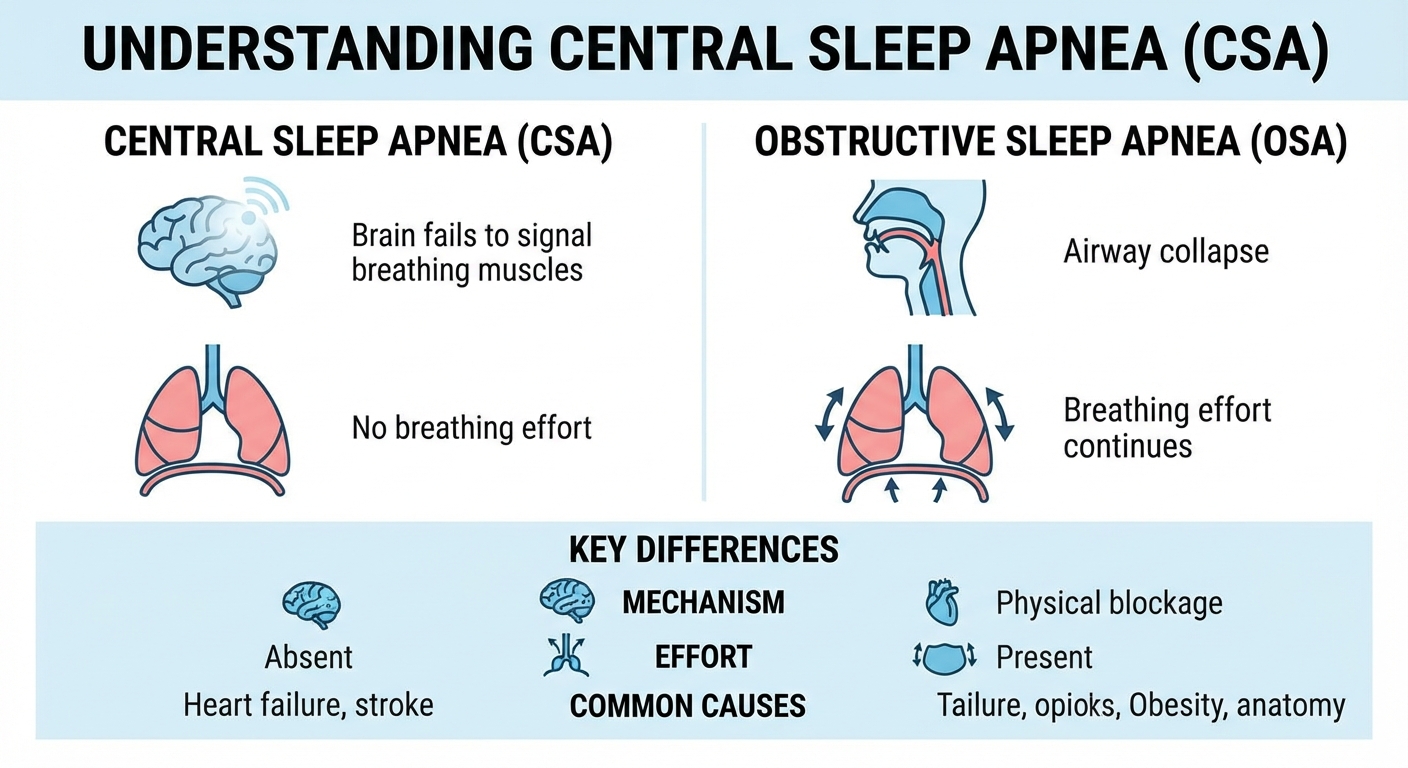
- Obstructive sleep apnea (OSA): the airway collapses and you keep trying to breathe against the blockage. CPAP is the standard treatment. See our complete guide to sleep apnea.
- Central sleep apnea (CSA): the brain does not send the signal to breathe, so there is no breathing effort during the pause. CPAP helps some people, but others need different approaches.
- Both together: many people have a mix, and central events can appear during treatment of obstructive apnea.
What causes central sleep apnea?
Several conditions and substances can cause it. Clinicians commonly list:
- Heart failure. Often described as the most common cause, with Cheyne-Stokes breathing. An unstable breathing control system, called increased loop gain, drives it.
- Stroke and other brain or brainstem disease, and some neurodegenerative conditions.
- Chronic opioid use. Opioids suppress the brain’s breathing rhythm.
- Atrial fibrillation, kidney failure, and spinal cord injury.
- High altitude.
- Starting PAP for obstructive apnea, which can unmask central events.
- Unknown causes, called primary or idiopathic central sleep apnea.
Because CSA is often tied to another condition, a medical evaluation matters even more than it does for obstructive apnea.
What are the symptoms of central sleep apnea?
There is no symptom that tells central from obstructive apnea reliably. Common symptoms include:
- Waking short of breath or gasping. See waking up gasping for air.
- A bed partner noticing pauses in breathing, sometimes in a waxing and waning pattern.
- Daytime sleepiness and fatigue.
- Fragmented sleep or insomnia.
- Morning headaches.
- In people with heart failure, swelling or breathlessness when lying flat.
You do not always snore loudly. See sleep apnea without snoring.
How is central sleep apnea diagnosed?

A sleep study (polysomnography) is the key test. It can show whether breathing effort continues during pauses (obstructive) or is absent (central). For central sleep apnea with Cheyne-Stokes breathing, the study must show a typical pattern, and central events must make up more than half of all apneas and hypopneas.
Because CSA is often secondary, doctors also look for causes. If a Cheyne-Stokes pattern is seen, a cardiac evaluation, including echocardiography, may be warranted. Brain or brainstem imaging may be considered for some neurological causes. See sleep apnea test cost for testing options.
How is central sleep apnea treated?
The main treatment is often to manage the underlying cause. Then devices or other therapies may be added. This is a specialist’s decision.
- Treat the underlying condition. For example, optimize heart failure care.
- Reduce or avoid opioids, alcohol, and other sedatives where possible. Do this only with your prescriber, and do not stop prescribed medicines on your own. See alcohol and sleep.
- PAP. CPAP may work for some people. Bilevel PAP with a backup rate is another option.
- Adaptive servo-ventilation (ASV). A device that adjusts pressure breath by breath. It carries an important safety warning, explained below.
- Oxygen. Low-flow oxygen is sometimes used.
- Medicine. Some specialists use a medicine called acetazolamide.
- Phrenic nerve stimulation. A pacemaker-like implant stimulates the phrenic nerve, which drives the diaphragm, to restore a normal breathing pattern.
- For treatment-emergent central apnea, the first step may be adjusting PAP settings or reducing the opioid dose, as directed by a clinician.
The ASV safety warning. In the SERVE-HF trial of 1,325 people with heart failure with reduced ejection fraction and predominantly central sleep apnea, adaptive servo-ventilation increased all-cause and cardiovascular mortality. The American Academy of Sleep Medicine issued a safety alert, and ASV is generally avoided in that group. A study guide summarizing a 2025 guideline update says carefully monitored use may be allowed in experienced centers after later trial data, so ask your sleep specialist and cardiologist what applies to you.
If you already use CPAP and have trouble, see can’t tolerate CPAP.
Is central sleep apnea dangerous?
It can be, because it often signals another condition and because each cycle can cause repeated drops in oxygen and arousals. Over time these can have detrimental effects, especially in people with heart failure. So take it seriously, and get evaluated.
Get emergency help for chest pain, severe shortness of breath, blue or gray lips, confusion, or fainting.
Waking up short of breath, or told that you stop breathing at night? A doctor and sleep specialist should lead. If you’d like help with the sleep habits and stress around it, book a consultation and we’ll work alongside your care team.
What can you do now? A step-by-step plan

- See a doctor if you have witnessed breathing pauses, regular gasping, or waking short of breath. Ask about a sleep study.
- Make a list of every medicine, including opioids, sleeping pills, and anything that makes you drowsy. Add alcohol use.
- Do not change or stop prescribed medicines on your own. Talk with your prescriber.
- Keep up heart and other medical follow-up if you have heart failure, a past stroke, or kidney problems.
- Go easy on alcohol and sedatives near bedtime.
- If you use CPAP and new breathing pauses appear, tell your sleep team. Treatment-emergent central apnea can need adjustment.
- Bring your bed partner’s observations to your visit.
What the Research Shows
It is a family of conditions, not one disease. A review in a sleep medicine journal notes that central apnea during sleep is not due to a single cause. It occurs in cycles, not isolated events. Increased loop gain, an unstable breathing control system, is the underlying mechanism in heart failure, and opioids suppress the brain’s breathing rhythm. The classification includes Cheyne-Stokes breathing, medical disorders, high altitude, medications, primary CSA, and treatment-emergent CSA.
SERVE-HF changed practice. The SERVE-HF trial randomized 1,325 people with heart failure with reduced ejection fraction and predominantly central sleep apnea to ASV plus medical treatment or medical treatment alone. The primary composite outcome did not differ significantly (54.1% versus 50.8%; hazard ratio 1.13, 95% confidence interval 0.97 to 1.31), but all-cause and cardiovascular mortality were significantly higher with ASV. Reviews note that the two largest PAP trials in heart failure with reduced ejection fraction, one with CPAP and one with ASV, were negative and both were associated with excess mortality.
Phrenic nerve stimulation is a newer option. A randomized trial of unilateral phrenic nerve stimulation found improvement in central sleep apnea, with fewer arousals, less sleepiness, and better quality of life. It is considered an option for adults with symptomatic, recurrent central sleep apnea.
Guidance continues to evolve. A study guide summarizing the AASM’s 2025 guideline lists conditional options of CPAP, bilevel PAP with a backup rate, ASV, acetazolamide, or transvenous phrenic nerve stimulation, with ASV in heart failure limited to experienced centers. Treat that as a pointer to ask your specialist, not as final guidance. Evidence for treatment-emergent central apnea suggests it may respond best to lower opioid doses, and ASV may be less effective there than in Cheyne-Stokes breathing.
This article is for education only and is not medical advice. Talk with a qualified clinician about your own sleep, health conditions, and medications.
If you would like to see how we might be able to help you with this deeper, schedule a free consult here.
Want a hand with the habits around your sleep?
Join The Sleep Nirvana Club, our free sleep course and community: Join the free sleep course and community.
When to Seek Professional Help
- Call emergency services for chest pain, severe shortness of breath, blue or gray lips, confusion, or fainting.
- You have witnessed breathing pauses, regular gasping, or you wake short of breath. See a doctor and ask about a sleep study.
- You have heart failure symptoms such as leg swelling, breathlessness when lying flat, or rapid weight gain. Seek prompt medical evaluation.
- You take opioids or other sedatives and have symptoms of sleep-disordered breathing. Talk with your prescriber, and do not stop abruptly.
- Breathing pauses appeared after you started CPAP, or CPAP is not working. Tell your sleep team.
- You feel persistently sad or hopeless, or have thoughts of self-harm. In the US, call or text 988 at any time.
Frequently Asked Questions
What is central sleep apnea?
Central sleep apnea (CSA) is a sleep breathing disorder in which the brain temporarily fails to signal the breathing muscles, so breathing stops without any blockage of the airway. Breathing pauses repeat in cycles during sleep, causing drops in oxygen and brief awakenings. It often occurs with heart failure, stroke, or opioid use, and it can emerge during CPAP treatment for obstructive sleep apnea. A sleep study is needed to diagnose it.
What causes central sleep apnea?
Common causes include heart failure, stroke, chronic opioid use, atrial fibrillation, and kidney failure. Other causes include high altitude, certain neurological conditions, and, in some people, the start of CPAP treatment for obstructive sleep apnea, called treatment-emergent central sleep apnea. In heart failure, an unstable breathing control system produces a crescendo-decrescendo pattern called Cheyne-Stokes breathing. Sometimes no cause is found, which is called primary central sleep apnea.
How is central sleep apnea different from obstructive sleep apnea?
In obstructive sleep apnea, the airway collapses during sleep and you keep trying to breathe against the blockage. In central sleep apnea, the brain does not send the signal to breathe, so there is no breathing effort during the pause. Both cause drops in oxygen and fragmented sleep, but they have different causes and treatments. A sleep study distinguishes them, and some people have both. Treating the underlying cause is often central to CSA care.
Can you treat central sleep apnea with CPAP?
Sometimes. CPAP helps some people with central sleep apnea, especially when the cause is treatable, but others need different approaches. Options include bilevel PAP with a backup rate, adaptive servo-ventilation, oxygen, phrenic nerve stimulation, and treating the underlying cause, such as heart failure or opioid use. If central events appear after you start CPAP, tell your sleep team, since this treatment-emergent pattern may need adjustment, such as lowering opioid doses with your prescriber.
Is adaptive servo-ventilation safe?
It depends on your heart health. In the large SERVE-HF trial of 1,325 people with heart failure with reduced ejection fraction and predominant central sleep apnea, adaptive servo-ventilation was linked to higher all-cause and cardiovascular mortality, and safety warnings advise against it in that group. People without that heart condition, or with other types of apnea, have different considerations. Newer guidance may allow carefully monitored use in specialist centers, so ask your sleep specialist and cardiologist.
When to Work With a Sleep Consultant
We do not diagnose or treat sleep apnea, and a doctor and sleep specialist should lead your care. What The Sleep Consultant can do is work alongside them. We look at the habits and root causes that affect your sleep, such as alcohol, stress, and circadian rhythm, so your nights recover while the medical causes are handled.


