

Night terrors in adults are episodes of sudden screaming, thrashing, or bolting upright with intense fear, usually in the first third of the night, followed by little or no memory. They are a non-REM parasomnia that affects about 1% to 3% of adults, unlike nightmares, which come from REM sleep and are remembered. Triggers include sleep deprivation, stress, alcohol, fever, shift work, some medicines, and sleep disorders like obstructive sleep apnea. In adults, night terrors can also go with anxiety, depression, or PTSD, so they deserve a medical look. Protect sleep, avoid alcohol near bedtime, treat triggers, and make the bedroom safe. See a sleep doctor if episodes are frequent, violent, or new in adulthood. Trying to calm someone mid-episode often does not work. This is educational information, not medical advice.
What are night terrors in adults?
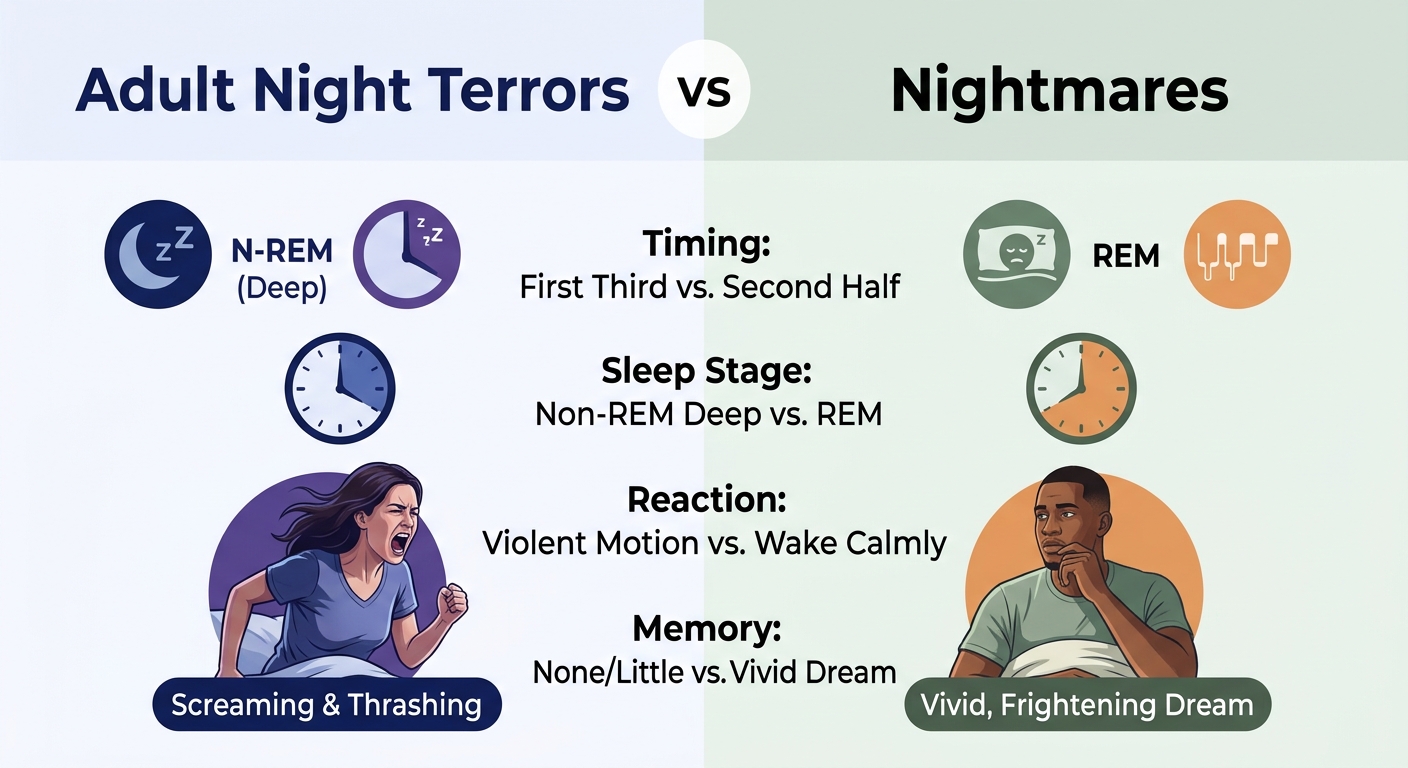
Night terrors, also called sleep terrors, are a type of parasomnia, which is an unusual behavior that happens during sleep. They occur during non-REM sleep, usually deep sleep. The person partly wakes, stays in a mixed state between sleep and wakefulness, and shows signs of fear without a remembered dream.
During an episode, a person may sit up abruptly, scream, thrash, or jump out of bed, with sweating, a racing heart, and dilated pupils. An episode can last from several minutes to 40 minutes, and others usually cannot calm the person down. Afterward, the person often does not remember anything.
Night terrors are most common in children. Up to 3% of adults have them, and episodes in adults can be more dramatic and can lead to injury. In a large UK survey, 2.2% of adults reported night terrors.
Here is how night terrors compare with similar events:
- Night terror: deep non-REM sleep, usually the first third of the night. Screaming or thrashing, hard to wake or calm, little or no memory.
- Nightmare: REM sleep, more common in the second half of the night. You wake scared and remember a vivid, frightening dream, and usually lie still.
- Sleepwalking and confusional arousals: also non-REM, and they often occur together with night terrors. See sleepwalking in adults.
- REM sleep behavior disorder: REM sleep, acting out a dream, usually after 50. See REM sleep behavior disorder.
What are the signs of night terrors in adults?
Common signs include:
- Sitting up abruptly or jumping out of bed.
- Screaming, crying, or other cries of fear.
- Sweating, a rapid heartbeat, and dilated pupils.
- Thrashing, kicking, or other sudden movements.
- Difficulty waking, with confusion or aggression if woken.
- No memory of the episode the next day.
What causes night terrors in adults?
No clear cause has been determined, but several things make them more likely:
- Sleep deprivation. After missing sleep, you spend more time in deep sleep the next time, and night terrors come from that stage.
- Stress and a disrupted schedule, including shift work.
- Alcohol and caffeine, and certain medicines, which may trigger episodes as a side effect.
- Fever. It can increase deep sleep.
- Sleep disorders that cause brief awakenings. These include obstructive sleep apnea and periodic limb movement disorder.
- Mental health conditions. Adults with night terrors may also have PTSD, an anxiety disorder, depression, or obsessive-compulsive disorder.
- Genes. Parasomnias run in families.
In the large UK survey, factors associated with night terrors included a sense of choking or blocked breathing at night (odds ratio 5.1), obstructive sleep apnea (4.1), alcohol at bedtime (3.9), and having nightmares at least once a month (4.0). These are associations and cannot prove cause.
If you also wake gasping or choking, read waking up gasping for air. Our guides to sleep apnea and alcohol and sleepexplain two common triggers.
Are night terrors in adults a sign of a mental health problem?
Sometimes, but not always. Night terrors in adults are often linked to stress, trauma, or anxiety. Adults with PTSD or another anxiety or mood disorder may be more likely to have them. The authors of the large UK survey concluded that arousal parasomnias, especially night terrors and confusional arousals, are often the expression of a mental disorder.
Still, that survey was self-reported and observational. Many adults with night terrors have no mental health condition, and sleep apnea, alcohol, and sleep loss are common triggers. So clinicians usually evaluate both sleep and mood in adults, and look for other sleep disorders if they are suspected.
Are night terrors in adults dangerous?

They are not harmful in themselves, but they can lead to injury in some cases. An adult may let out a piercing scream or move out of bed violently. Episodes can also frighten and disrupt partners and housemates.
So take safety seriously. Clear the area around the bed, move hard or sharp objects, and consider padding. Lock doors and windows if you tend to leave the bed.
Do night terrors leave you dreading bedtime? If you’d like help with the habits and stress behind fragmented sleep, book a consultation and we’ll work alongside your doctor. A sleep doctor should rule out other disorders first.
How are night terrors in adults diagnosed?
Diagnosis is usually based on a description of the episodes, not a test. A clinician asks about your sleep history, family history of sleep disorders, and underlying conditions. A bed partner’s account helps a lot, and a sleep diary is useful.
A sleep study (polysomnography) may be recommended if symptoms are severe, frequent, or hard to tell apart from other sleep disorders such as seizures or sleepwalking. It records brain activity, breathing, heart rate, and muscle movements.
How do you stop night terrors in adults? A step-by-step plan

There is no single cure, and treatment focuses on reducing how often they happen and how much they affect you:
- Protect your sleep. Keep a regular schedule with a consistent wake time and enough hours. Sleep loss can trigger episodes the next time you sleep.
- Avoid alcohol and caffeine, especially near bedtime.
- Reduce sleep disruptions. Since episodes tend to occur with brief awakenings, keep pets out of the bedroom and block noise.
- Manage stress. Cognitive behavioral therapy and relaxation can help with thoughts and habits that contribute. See anxiety and insomnia.
- Review medicines with your prescriber. Some can trigger episodes. Do not stop a prescribed medicine on your own.
- Treat sleep apnea and limb movement disorder if you have them, because they cause brief awakenings.
- Make the bedroom safe.
- Ask about doctor-guided options if episodes are frequent, severe, or disruptive. These include scheduled awakenings shortly before the time episodes usually occur, therapy, or, in severe cases, medicine.
During an episode, stay calm and keep the space safe. Trying to calm the person often does not work, and may upset them more. Keep your distance if they seem agitated, and guide them gently back to bed afterward.
Be aware that evidence for treatments is limited. A 2023 systematic review found only limited support for behavioral and psychological treatments of non-REM parasomnias, so work with a sleep specialist.
What the Research Shows
A large survey gave prevalence figures. A 1999 study in the Journal of Clinical Psychiatry interviewed a representative sample of 4,972 UK adults by telephone. Night terrors were reported by 2.2%, sleepwalking by 2.0%, and confusional arousals by 4.2%. The rates of all three fell significantly with age, with no gender difference. The authors noted that the figures come from self-report and are probably underestimates.
The same survey identified associated factors. Factors linked with night terrors included a subjective sense of choking or blocked breathing at night (odds ratio 5.1), obstructive sleep apnea syndrome (4.1), alcohol consumption at bedtime (3.9), nightmares at least one night a month (4.0), and hypnagogic hallucinations (2.2). The authors concluded that arousal parasomnias, especially night terrors and confusional arousals, are often the expression of a mental disorder, and that other conditions, such as shift work, may also trigger them. It is an association study, so it cannot show cause and effect.
Clinical sources point to sleep disruptors and mental health. Sleep Foundation reviews note that sleep disorders that cause brief awakenings, such as obstructive sleep apnea and periodic limb movement disorder, are linked to night terrors, and that adults with night terrors may also have PTSD, an anxiety disorder, or another mental health issue. A sleep-medicine review estimates night terrors occur in 1% to 2% of adults and says depression, anxiety, PTSD, phobias, and obsessive-compulsive disorder should be evaluated.
Treatment evidence is limited. A 2023 systematic review in Sleep Medicine found 76 publications on behavioral and psychological treatments for non-REM parasomnias, 44 of them in adults. Limitations in study design and outcome measures meant the evidence was limited, but it provided some support for multicomponent CBT, sleep hygiene, scheduled awakenings, and hypnosis. Sleep Foundation also lists scheduled awakenings as an option for frequent or severe episodes.
This article is for education only and is not medical advice. Talk with a qualified clinician about your own sleep, health conditions, and medications.
If you would like to see how we might be able to help you with this deeper, schedule a free consult here.
Want a hand with the habits behind calmer nights?
Join The Sleep Nirvana Club, our free sleep course and community: Join the free sleep course and community.
When to Seek Professional Help
- Episodes are frequent, violent, or have caused injury or put you or others at risk. See a sleep doctor, and make the bedroom safe now.
- Night terrors are new in adulthood, or come with choking, gasping, or loud snoring. Ask about a sleep study to check for sleep apnea.
- Episodes involve stiffening, jerking, or the same movements repeated several times a night. Ask for a medical evaluation, since seizures can look like sleep events.
- You have trauma, panic, or constant worry, or feel persistently sad or hopeless, or have thoughts of self-harm. A mental health professional can help. In the US, you can call or text 988 at any time.
- Episodes began after a new medicine, or after a change in alcohol use. Tell your prescriber, and do not stop a medicine on your own.
Frequently Asked Questions
What are night terrors in adults?
Night terrors, also called sleep terrors, are episodes of sudden intense fear during deep non-REM sleep, in which a person may scream, sit up, thrash, or leave the bed with a racing heart and sweating. They usually happen in the first third of the night, can last from several minutes to 40 minutes, and are usually not remembered. They affect roughly 1% to 3% of adults, and episodes in adults can be more dramatic than in children.
What causes night terrors in adults?
No single cause is known, but triggers include sleep deprivation, irregular schedules, stress, fever, alcohol, caffeine, some medicines, and sleep disorders that cause brief awakenings, such as obstructive sleep apnea and periodic limb movement disorder. Genetics play a role, since parasomnias run in families. In adults, night terrors are also linked with anxiety, depression, PTSD, and other mental health conditions, so a clinician may look at both sleep and mood.
What is the difference between night terrors and nightmares?
Night terrors come from deep non-REM sleep, usually early in the night. The person may scream and thrash, is hard to wake or calm, and usually remembers nothing. Nightmares come from REM sleep, more often later in the night. The person typically wakes up scared and remembers a vivid, frightening dream, and usually stays still in bed. A night terror is a partial arousal, while a nightmare is a dream that wakes you.
Are night terrors in adults a sign of PTSD or anxiety?
They can be. Adults with night terrors are more likely to have PTSD, anxiety disorders, depression, or other mental health conditions, and a large UK survey concluded night terrors are often an expression of a mental disorder. But many adults with night terrors have no mental health condition, and sleep apnea, alcohol, and sleep loss are common triggers. Because the picture varies, ask a clinician to look at both your sleep and your mood.
How do you stop night terrors in adults?
Start with sleep and triggers. Keep a regular schedule and get enough sleep, avoid alcohol and caffeine, limit disruptions such as noise or pets, manage stress, review medicines with your prescriber, and treat sleep apnea or limb movement disorder if present. Make the bedroom safe. If episodes are frequent, severe, or disruptive, a doctor may suggest scheduled awakenings, therapy, or medicine. Treatment evidence is limited, so work with a sleep specialist.
When to Work With a Sleep Consultant
We do not diagnose or treat night terrors, and a sleep doctor should rule out sleep apnea, seizures, and other disorders first. What The Sleep Consultant can do is work alongside them. We look for the root causes that fragment your sleep, such as an irregular schedule, alcohol, stress, and circadian rhythm, so your nights can calm down.


