

Orthosomnia is an unofficial term for an unhealthy preoccupation with achieving perfect sleep scores on a sleep tracker, which can create the stress and habits that make sleep worse. Researchers coined it in a 2017 case series, and it is not a formal diagnosis. Consumer trackers cannot accurately tell sleep stages or diagnose sleep disorders, and sham negative feedback made people with insomnia feel worse the next day. Use trackers as rough trends, not nightly grades: judge sleep by how you feel, stop chasing numbers, avoid extra time in bed, and take a break from the data if it spikes your anxiety. See a clinician if poor sleep or tracker worry lasts for weeks; CBT-I is the first-line treatment. This is educational information, not medical advice.
What is orthosomnia?
Orthosomnia is a proposed term for a preoccupation with improving or perfecting wearable sleep data. Researchers at Rush University and Northwestern coined it in a 2017 paper in the Journal of Clinical Sleep Medicine. “Ortho” means straight or correct, and “somnia” means sleep. The name echoes orthorexia, an unhealthy preoccupation with healthy eating.
It is not a formal diagnosis. There is no standard definition or list of symptoms, and what we know comes from small case studies. In those cases, people trusted tracker data over validated tests, and some felt the data matched their experience better than a sleep study did.
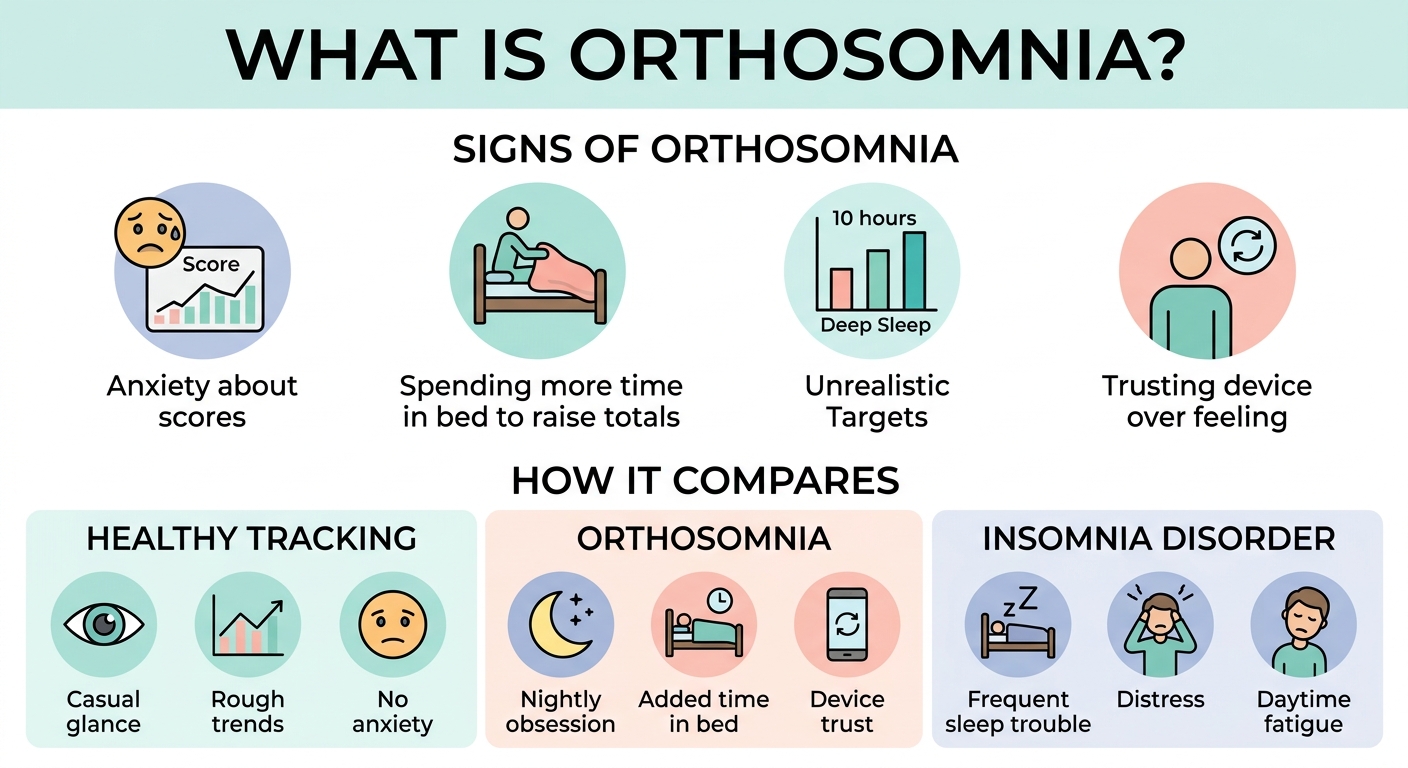
Here is how it compares with similar patterns:
- Healthy tracking: you glance at trends over weeks, treat the numbers as rough, and do not change your bedtime behavior because of them.
- Orthosomnia: a nightly score decides your mood, you add time in bed to raise totals, you trust the device over how you feel, and bedtime brings anxiety.
- Insomnia disorder: trouble sleeping at least three nights a week for at least three months, with distress or daytime problems. The two can overlap.
What are the signs of orthosomnia?
Signs reported in case studies and by sleep experts include:
- Anxiety about scores. Your mood depends on the number each morning.
- Spending more time in bed to raise the tracker’s sleep total. Each patient in the original case series did this, which is the opposite of what sleep therapists recommend.
- Unrealistic targets. One patient aimed to achieve at least 8 hours of deep sleep a night.
- Trusting the device over your own experience, or over a sleep study.
- Seeking treatment for “light” or “restless” sleep you only noticed on a tracker.
- Checking the app first thing and letting it set your day.
Why can tracking your sleep make it worse?
There are four main reasons.
- The data are shaky. Studies show consumer trackers cannot accurately tell sleep stages and have poor accuracy in detecting time awake after sleep onset. As one of the authors put it, they might call it sleep when you are reading in bed.
- The pressure creates arousal. Trying to hit a number adds effort and worry, which raises alertness. See sleep anxiety.
- It changes behavior. People stay in bed longer to raise the total, and long time in bed can weaken sleep.
- Feedback biases how you feel. In a controlled experiment, 63 adults with insomnia wore an actigraphy watch and received sham feedback each morning. Those told they slept badly felt less alert and more fatigued that evening than those told they slept well, even though the feedback was made up.
Are sleep trackers accurate?
Not for the details. The American Academy of Sleep Medicine (AASM) says consumer sleep technology lacks validation and FDA clearance, so it cannot be used to diagnose or treat sleep disorders at this time. It can still enhance the conversation between you and your clinician when discussed in the context of a proper evaluation.
They are better for rough trends than for nightly grades. In the original case series, one patient’s tracker data helped lead to a sleep apnea evaluation, but the authors stress that trackers are not a valid technique for diagnosing apnea. See our deeper look at sleep tracker accuracy.
Does your sleep score run your mornings, or does your own tracker make you more anxious about sleep? If that sounds like you, book a consultation and we’ll look for the root causes behind your sleep and the worry around it.
How do you stop orthosomnia? A step-by-step plan

No trial has tested these steps for orthosomnia, and sleep experts say more research is needed. They are adapted from CBT-I principles and from the original authors’ advice to build tracker use into CBT-I:
- Judge sleep by how you feel and function, not by the score.
- Look at weekly trends, not nightly numbers. Check once a day or less, and consider turning off score notifications.
- Do not open the app first thing. Let your morning start before the data does.
- Do not add time in bed to raise your total. Keep a regular schedule instead. See CBT-I.
- Take a break from the tracker for a few weeks if your anxiety spikes, and see how you feel without it.
- Set goals for behaviors, not metrics: a steady wake time, morning light, and a wind-down routine.
- Treat the stress. See anxiety and insomnia.
- If sleep stays poor, see a clinician and bring your data along. The AASM says anyone with an ongoing sleep problem should discuss it with a licensed medical provider, regardless of what a device says.
Can you still use a sleep tracker?

Yes, with rules. The lead author of the original paper said tracking is a good way to see approximately how much sleep you are getting, and that realistic use of monitors can be beneficial. Try these rules:
- Use it for patterns over weeks, such as your usual bedtime and wake time.
- Ignore the stage breakdown. Light, deep, and REM estimates are the least reliable part.
- Do not use it to diagnose. Snoring, gasping, or severe sleepiness need a clinician. See HRV and sleep quality for how to read recovery numbers calmly.
- Stop if it raises your anxiety.
For how efficiency works in real sleep, see sleep efficiency.
What the Research Shows
The original report is a small case series. In 2017, Baron and colleagues described patients who sought treatment for self-diagnosed sleep disturbances, such as too little sleep or insomnia, based on periods of light or restless sleep on a tracker. To these patients, the tracker data often felt more consistent with their experience than validated tests such as polysomnography or actigraphy. Each patient in the case series spent more time in bed to boost the tracker total. The authors suggested that tracker data can fuel a perfectionistic quest for ideal sleep and recommended working trackers into CBT-I. A case series cannot tell us how common the problem is.
A controlled experiment shows how feedback shapes feelings. In a 2018 study in the Journal of Sleep Research, 63 adults with insomnia disorder were randomized to next-day sham feedback about sleep. Those given negative feedback (n = 32) had lower alert cognition (effect size 0.79) and more sleepiness and fatigue (0.55) in the evening than those given positive feedback (n = 31). There were no differences in sleep-related attentional bias or psychomotor vigilance. The authors concluded that sham feedback biases how people appraise daytime symptoms, which has implications for wearables that may be inaccurate relative to gold-standard measurement.
The AASM is cautious about consumer devices. A 2018 position statement in the Journal of Clinical Sleep Medicine said that, given the lack of validation and FDA clearance, consumer sleep technologies cannot be used for the diagnosis or treatment of sleep disorders at this time. They may enhance patient-clinician interaction in the context of an appropriate evaluation. The statement called for future validation, access to raw data and algorithms, and FDA oversight.
Experts say the picture is still emerging. The Sleep Foundation notes that current understanding of orthosomnia rests on case studies of small numbers of people and that additional research is needed, especially as trackers improve and more people use them over long periods. Roughly 30% of US adults use a wearable device for health data, and researchers suggest smartphone-based sleep tracking is currently inaccurate and ineffective.
This article is for education only and is not medical advice. Talk with a qualified clinician about your own sleep, health conditions, and medications.
Want a hand with your relationship to sleep data?
Join The Sleep Nirvana Club, our free sleep course and community: Join the free sleep course and community.
When to Seek Professional Help
- Poor sleep or tracker-related worry has lasted weeks, or you have trouble sleeping at least three nights a week for three months or more. Ask about CBT-I.
- Bedtime anxiety feels hard to control, or you have panic symptoms. A mental health professional can help.
- You snore loudly, gasp at night, or feel very sleepy even when your tracker says you slept well. Trackers cannot diagnose sleep apnea, so ask about a sleep study.
- You feel persistently sad or hopeless, or have thoughts of self-harm. Contact a clinician right away, and in the US you can call or text 988 at any time.
- You are using alcohol or sleep medicine to chase better scores. Talk with a clinician about safer options.
Frequently Asked Questions
What is orthosomnia?
Orthosomnia is an unofficial term for an unhealthy preoccupation with achieving perfect sleep scores on a sleep tracker. Researchers at Rush University coined it in 2017, from ortho, meaning correct, and somnia, meaning sleep, after seeing patients who sought treatment for sleep problems based on tracker data. The worry and habits that come with chasing the numbers, such as spending more time in bed, can make sleep worse.
Is orthosomnia a real diagnosis?
Not yet. Orthosomnia is a proposed term, and there is no standard definition or symptom list. What we know comes mostly from small case studies, including a 2017 case series of three patients. Sleep experts say more research is needed. That does not mean the problem is imaginary: sham feedback experiments show that negative sleep scores can make people with insomnia feel worse the next day. If you are distressed, a sleep clinician can help.
Do sleep trackers make sleep worse?
They can for some people. Case reports describe people spending more time in bed to improve their tracker totals, and an experiment in people with insomnia found that sham negative sleep feedback made them feel less alert and more fatigued in the evening than sham positive feedback. Many people use trackers without problems. If the data raises anxiety or changes your behavior, scale back and focus on how you feel.
Are sleep trackers accurate?
Not very, for details. The American Academy of Sleep Medicine says consumer sleep technology lacks validation and FDA clearance for diagnosing or treating sleep disorders. Studies show wearables cannot accurately tell sleep stages and are poor at detecting wake after sleep onset, and they may count lying still in bed as sleep. They are better for rough trends over weeks than for nightly scores. Talk to a clinician about ongoing sleep problems regardless of what your device says.
How do I stop obsessing over my sleep score?
Judge your sleep by how you feel and function, not the score. Look at weekly trends instead of nightly numbers, turn off sleep score notifications, and avoid checking the app first thing. Do not add extra time in bed to raise your totals. If your anxiety spikes, take a break from the tracker for a few weeks. If poor sleep or worry lasts for weeks, ask about CBT-I, the first-line treatment for chronic insomnia.
When to Work With a Sleep Consultant
If a number runs your mornings, or you sleep poorly despite good habits, a deeper cause may be involved: your stress response, circadian rhythm, hormones, or nutrient status. The Sleep Consultant looks for those root causes instead of handing you another metric to chase.


