Vagus Nerve Exercises for Sleep: How to Calm Your Nervous System at Night
You’ve heard the standard advice: “relax before bed.” Read a book. Take a bath. Put the phone down. And those things can help — at the margins. But if your nervous system is genuinely stuck in sympathetic overdrive, surface-level relaxation is like whispering “calm down” to someone mid-panic attack. The right sentiment. The wrong tool.
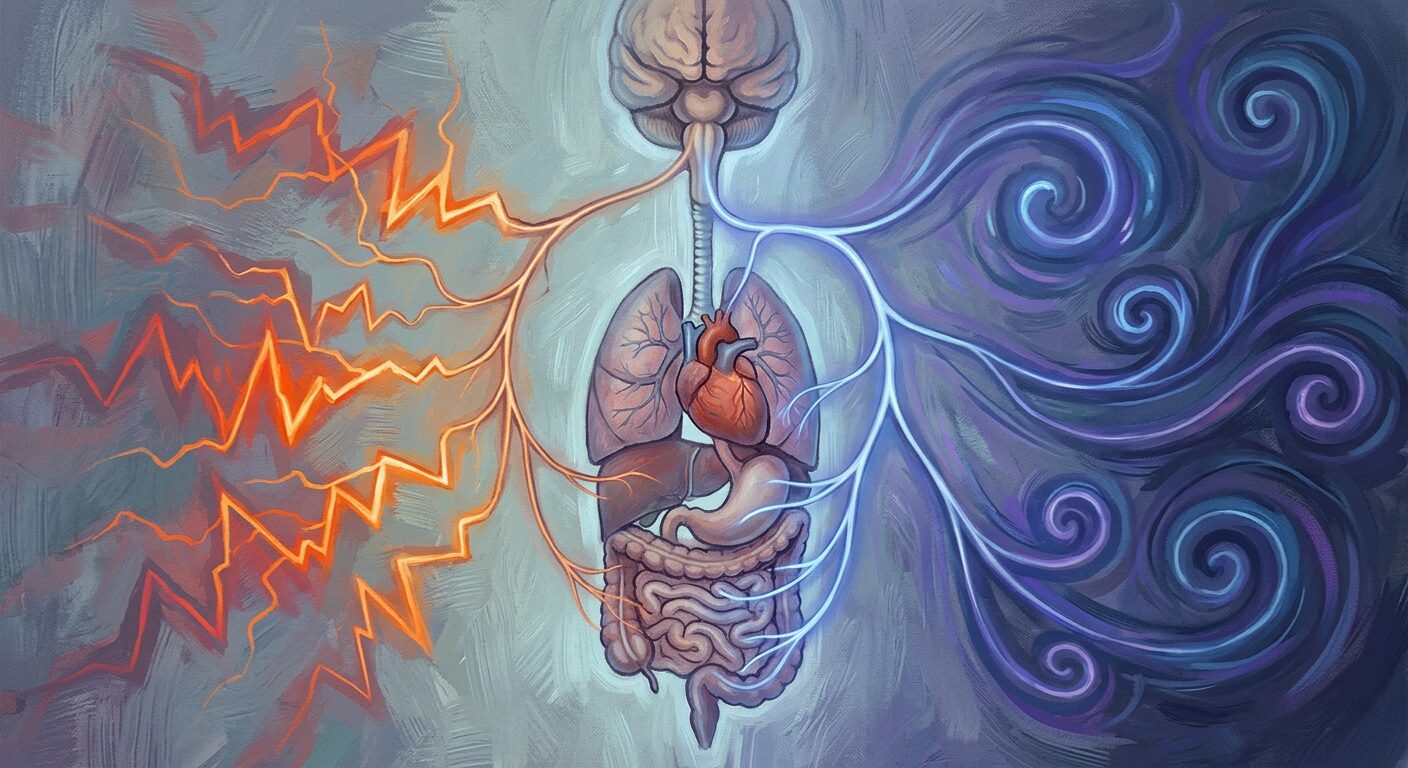
The right tool is your vagus nerve — the longest cranial nerve in the body and the master switch for the parasympathetic “rest and repair” system. When you activate it deliberately, the effect isn’t vague or gradual. Heart rate drops. Breathing deepens. Muscle tension releases. Blood pressure falls. The body shifts toward a measurable physiological state that allows sleep to happen.
These aren’t wellness platitudes. They’re specific inputs that trigger specific autonomic responses, backed by research and measurable on any heart rate variability monitor. Here are seven of the most effective techniques, exactly how to do them, and when to use each one.
Why Vagal Activation Works for Sleep
Sleep onset isn’t passive. It requires an active shift from sympathetic (fight-or-flight) to parasympathetic (rest-and-repair) dominance. The vagus nerve drives that shift. Every technique below works by sending a specific signal through one of the vagus nerve’s branches — in the diaphragm, the throat, the face, or the gut — that tells the brain: the threat is over. It’s safe to power down.
The response is measurable. Within minutes of proper vagal activation, heart rate variability (HRV) increases, respiratory rate slows, and skin conductance drops. These are the same autonomic markers that precede natural sleep onset. You’re not tricking the body into sleeping. You’re giving it the specific input it needs to begin the transition. For a complete explanation of the vagus nerve’s role in sleep, see our pillar article: Vagus Nerve and Sleep.
Seven Evidence-Based Vagus Nerve Exercises for Sleep
1. Extended Exhale Breathing
The single most accessible and well-studied vagal activation technique. The exhale phase of breathing stimulates the vagus nerve through the baroreceptor reflex — as you breathe out, blood pressure drops slightly, baroreceptors detect the change, and the vagus nerve fires to slow the heart. Over multiple breath cycles, this shifts the entire autonomic balance toward parasympathetic.
Inhale through the nose for 4 seconds
Exhale slowly through the nose or mouth for 6–8 seconds
Aim for 5–6 complete breath cycles per minute
Continue for 5–10 minutes, lying in bed with eyes closed
The extended exhale is the active ingredient. Research in Psychophysiology confirms that breathing at this rate maximises respiratory sinus arrhythmia — the natural HRV oscillation driven by vagal activity. If you change one thing about your bedtime routine, make the exhale longer than the inhale.
2. Cold Water Dive Reflex
Splashing cold water on the face — or holding a cold, damp cloth over the forehead and cheeks for 15–30 seconds — triggers the mammalian dive reflex. This is an involuntary vagal response that rapidly drops heart rate and shifts autonomic tone toward parasympathetic within 10–15 seconds. Studies in the European Journal of Applied Physiology confirm the mechanism: facial cold exposure activates the trigeminal-vagal reflex pathway.
Best used 15–30 minutes before getting into bed, as a “phase transition” tool between evening activity and the sleep environment. The effect is immediate and noticeable — many people describe an instant sense of calm that’s more powerful than anything they’ve experienced from relaxation techniques.
3. Humming and Vocal Vibration
The vagus nerve innervates the muscles at the back of the throat. Sustained humming, chanting “om,” or singing at a comfortable pitch activates these branches through mechanical vibration. Research has shown that humming increases nasal nitric oxide production (improving sinus function) and shifts autonomic tone toward parasympathetic dominance.
Try 2–3 minutes of sustained humming during the wind-down routine — while brushing teeth, while getting into pyjamas, or sitting on the edge of the bed. The practice requires no equipment, no special skill, and becomes more effective with daily repetition as vagal tone strengthens.
4. Vigorous Gargling
Gargling hard enough to contract the muscles at the back of the throat and bring your eyes to slight tears activates the same vagal branches as humming, but through muscular contraction rather than vibration. The intensity matters — gentle gargling doesn’t produce enough contraction to stimulate the vagus meaningfully.
Gargle with water for 30–60 seconds, twice daily. Best done earlier in the evening routine (not right at bedtime, as the vigorous contraction can be temporarily activating). Over 2–4 weeks of daily practice, the cumulative effect on baseline vagal tone becomes significant.
5. Progressive Muscle Relaxation (PMR)
PMR systematically tenses and releases muscle groups from feet to head. The release phase is the active ingredient — it activates the vagus nerve’s “safety” signal, telling the brain that the body is not under physical threat. Meta-analyses consistently show PMR reduces sleep onset latency and improves sleep quality, with effects attributed to the autonomic shift produced by the tension-release cycle.
A 10–15 minute PMR sequence lying in bed works well as the final pre-sleep activity. Move slowly through each group: feet, calves, thighs, abdomen, hands, arms, shoulders, face. Tense for 5 seconds, release completely, and spend 10–15 seconds noticing the contrast between tension and relaxation before moving to the next group.
6. Gentle Abdominal Self-Massage
Slow, clockwise abdominal massage stimulates vagal nerve endings in the gut wall. The vagus nerve has extensive branches throughout the intestinal tract, and gentle mechanical stimulation of this area sends calming afferent signals to the brainstem. This technique is particularly useful for people whose sleep problems coexist with digestive sluggishness — a sign of low vagal digestive output.
Use gentle pressure with the fingertips, moving clockwise around the navel for 3–5 minutes. The clockwise direction follows the natural path of the colon. This supports both vagal tone and digestive motility overnight.
7. Legs-Up-the-Wall (Viparita Karani)
Lying on your back with legs elevated against a wall for 5–10 minutes shifts blood volume toward the core. The increased venous return triggers baroreceptor-mediated vagal activation — the same reflex mechanism that makes extended exhale breathing work, but achieved passively through gravity rather than actively through breathing.
It’s a low-effort technique that works well as a transition between evening activity and getting into bed. Many people find it naturally calming without needing to “try” to relax — the autonomic shift happens automatically.
How to Build a Pre-Sleep Vagal Routine
You don’t need all seven exercises every night. Pick 2–3 that resonate and build a consistent 10–15 minute sequence. Consistency matters far more than variety — a simple routine done nightly builds cumulative vagal tone, while rotating through different techniques prevents that accumulation.
A sample routine that works well:
60 minutes before bed: gargling while getting ready for the evening (30–60 seconds)
30 minutes before bed: cold water on the face (dive reflex) + 3 minutes of sustained humming
In bed: 5–10 minutes of extended exhale breathing (4 in, 6–8 out), transitioning directly into sleep
If you wear a sleep tracker, monitor your nighttime HRV. You should see a measurable increase within 1–3 weeks of consistent practice. That increase is the vagus nerve getting stronger — objective evidence that the exercises are working.
What the Research Shows
Slow breathing and HRV: Research confirms that breathing at 5–6 breaths per minute maximises respiratory sinus arrhythmia, with both acute effects (within a single session) and chronic effects (elevated baseline HRV after weeks of practice).
Vagus nerve stimulation and insomnia: A 2021 study in the Journal of Clinical Sleep Medicine found that transcutaneous auricular vagus nerve stimulation improved both subjective and objective sleep measures in chronic insomnia patients, validating the principle that vagal activation directly improves sleep.
Dive reflex: Studies in the European Journal of Applied Physiology demonstrate that facial cold exposure produces rapid heart rate deceleration and sympathetic withdrawal within 10–15 seconds via the trigeminal-vagal reflex.
PMR and sleep: Meta-analyses confirm PMR reduces sleep onset latency and improves sleep quality across populations, with the strongest effects in people with stress-related or hyperarousal insomnia.
When Exercises Hit a Ceiling
Vagal exercises are powerful tools. But they have a biological ceiling when the vagus nerve is being actively impaired at its source. If exercises help you relax but can’t fully resolve the insomnia, one of these deeper issues is likely at play:
Gut infections (H. pylori, parasites) inflaming vagal nerve endings in the intestinal wall — the nerve is being damaged faster than exercises can strengthen it
Chronic systemic inflammation suppressing vagal output through the cholinergic anti-inflammatory pathway
Nutrient deficiencies (magnesium, B6, zinc) limiting the neurotransmitter production that vagal function depends on
Physical damage to the vagus nerve from neck injury, surgery, or cervical misalignment
This is the critical distinction: exercises strengthen the nerve’s output. But if the nerve itself is under biological attack, output training alone can’t keep up. The source of impairment needs to be identified and resolved. That’s where investigation begins.
This information is educational and not medical advice. Persistent sleep problems warrant professional investigation.
What are the best vagus nerve exercises for sleep?
The most effective evidence-based techniques are extended exhale breathing (4 seconds in, 6–8 out), cold water face immersion (dive reflex), humming, vigorous gargling, progressive muscle relaxation, abdominal self-massage, and legs-up-the-wall. Extended exhale breathing is the most accessible and can be done in bed immediately before sleep.
How quickly do vagus nerve exercises work for sleep?
Individual sessions produce effects within minutes — heart rate slows, breathing deepens, tension releases. Cumulative improvements in baseline vagal tone and sleep quality become measurable on HRV monitors within 1–3 weeks of daily practice.
Can vagus nerve exercises cure insomnia?
They can significantly improve insomnia driven by nervous system dysregulation. However, if vagal dysfunction is caused by a gut infection, chronic inflammation, or nutrient deficiency, exercises alone may not be sufficient. They address the nerve’s output but not the source of its impairment.
When should I do vagus nerve exercises for sleep?
Build a 10–15 minute routine in the 30–60 minutes before bed. Gargling and humming work well earlier in the evening. Extended exhale breathing is most effective lying in bed as the last thing before sleep.
Why isn’t deep breathing fixing my insomnia?
If breathing helps you relax but doesn’t resolve the insomnia, the vagus nerve may be impaired by a gut infection, chronic inflammation, or nutrient depletion. The exercises strengthen the nerve’s output, but if the nerve itself is under biological stress, improvement has a ceiling that only root-cause treatment can lift.
When to Work With a Sleep Consultant
If you’ve tried the breathing, the cold water, the humming — and your nervous system still won’t switch off at night — the vagus nerve likely needs more than exercise. It needs the source of its impairment identified and resolved. That’s the investigation that changes everything.
Riley Jarvis at The Sleep Consultant works with clients to uncover the root biological causes behind chronic sleep issues and build personalised protocols that address every layer — not just the symptoms.