

REM sleep behavior disorder (RBD) is a sleep disorder in which the normal muscle paralysis of REM sleep is lost, so you physically act out vivid dreams by shouting, punching, or kicking. It usually begins after age 50, is more common in men, and often shows up later in the night. RBD can injure you or a bed partner, so safety and a sleep study are essential. Isolated RBD is strongly linked to later Parkinson disease or Lewy body dementia, so ask a neurologist about follow-up. Treatment usually combines bedroom safety with melatonin or clonazepam, chosen with a specialist. Antidepressants and alcohol can trigger it, so review medicines with your prescriber. Do not self-treat; see a sleep doctor. This is educational information, not medical advice.
What is REM sleep behavior disorder?
RBD is a parasomnia, an unwanted behavior that happens during sleep. During normal REM sleep, the body is temporarily paralyzed, which is called atonia, while the brain is active and dreaming. In RBD, that paralysis does not fully occur, so people can physically act out their dreams.
That can range from small twitches and quiet sleep talking to loud shouting, punching, kicking, grabbing a bed partner, and jumping out of bed. REM sleep gets longer in the second half of the night, so episodes often happen later in the sleep period.
It is not common. One review reported that video-polysomnography-confirmed RBD affects about 0.68% of people (range 0.29% to 1.15%), while studies of probable RBD report a much higher rate of about 5.65%. The average age of onset is about 61, and most people with it are men.
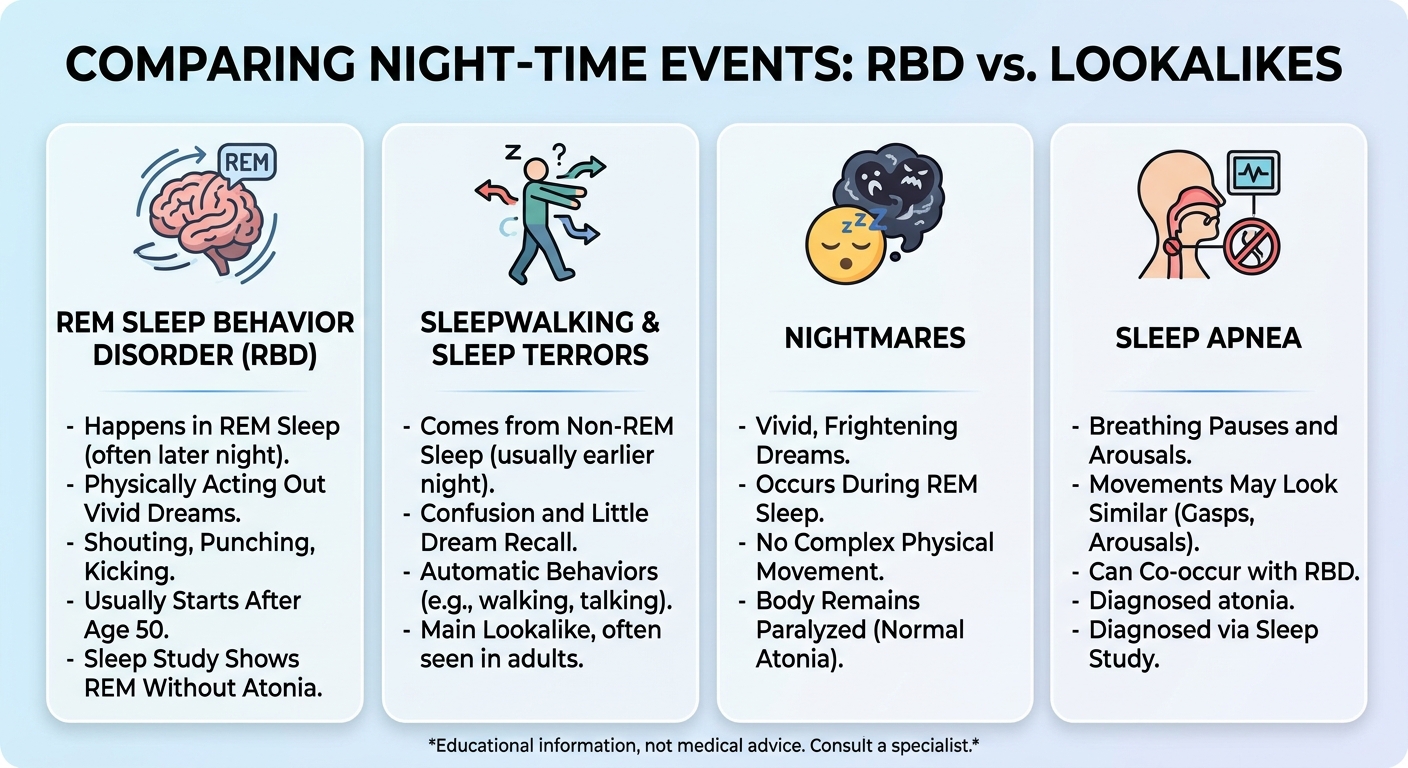
Here is how RBD differs from other night-time events:
- RBD: happens in REM sleep, often later in the night, and involves acting out a dream. Usually starts after 50. A sleep study shows REM sleep without atonia.
- Sleepwalking and sleep terrors: come from non-REM sleep, usually earlier in the night, with confusion and little dream recall. Doctors rank this as the main lookalike. See sleepwalking in adults.
- Nightmares: vivid dreams without the movement.
- Sleep apnea: can cause arousals that look similar, and doctors look for it during the work-up. See our complete guide to sleep apnea.
What are the signs of REM sleep behavior disorder?
Common signs, often noticed first by a bed partner, include:
- Shouting, talking, laughing, or swearing in your sleep.
- Flailing, punching, kicking, or grabbing.
- Falling or jumping out of bed.
- Waking with bruises or injuries, or injuring a partner.
- Vivid, often frightening dreams, such as being chased or attacked, that match what your partner saw.
Because it can be violent, RBD can put you and anyone who shares your bed at risk of injury. For milder night-time talking, see sleep talking in adults.
What causes REM sleep behavior disorder?
The underlying problem is disruption of the brain pathways that normally keep muscles quiet in REM sleep. Many cases are called isolated or idiopathic RBD, meaning no other cause is found at first. Other contributors include:
- Neurological conditions. RBD often coexists with Parkinson disease, Lewy body dementia, and multiple system atrophy, and may come before them.
- Narcolepsy.
- Medicines. Antidepressants, including tricyclics and SSRIs, can bring it on.
- Alcohol or drugs, including withdrawal.
- Genes. Variants in the GBA gene are more common in people with isolated RBD (9.5%) than in people without it (4.1%).
- Other possible factors: head injury, pesticide exposure, smoking, and sleep deprivation have been suggested, but more research is needed.
Is REM sleep behavior disorder a sign of Parkinson’s or dementia?

Often, over time, when no other cause is found. This is hard to read, so here is the honest picture.
Experts call RBD the strongest known predictor of neurodegeneration, specifically the alpha-synucleinopathies: Parkinson disease, dementia with Lewy bodies, and multiple system atrophy. In a large multicenter study of 1,280 people with isolated RBD at 24 centers, about 6.3% per year converted to one of these conditions, and the risk reached 73.5% after 12 years. The median time to conversion was about 8 years.
Two things matter alongside those numbers. First, it takes years: the risk rises with the duration of RBD. Second, RBD itself is treatable, and knowing about it gives you and your neurologist time to plan, monitor, and consider future research options. Some experts stress that RBD is a window for future neuroprotection trials.
If you or a partner notice dream enactment, see a sleep doctor, and ask whether a neurologist should follow you.
How is REM sleep behavior disorder diagnosed?
A sleep doctor reviews your history, including what a bed partner observes, and does a physical and neurological exam to rule out other causes such as medicines, alcohol, and narcolepsy. They will also look for signs of Parkinson disease, such as tremor or stiffness.
The diagnosis rests on a sleep study. International criteria require repeated vocalizations or complex movements during sleep, confirmed to occur in REM sleep by polysomnography or by a clinical history of dream enactment, plus REM sleep without atonia on the sleep study, and no better explanation by another disorder. Video polysomnography is considered necessary for a definite diagnosis.
How is REM sleep behavior disorder treated, and how do you stay safe?
Safety comes first, then triggers, then medicine if episodes are frequent or dangerous.
Make the bedroom safer (common-sense steps):
- Move the bed away from windows and hard furniture.
- Clear sharp, breakable, or heavy objects from around the bed.
- Pad the bed edges, or lower the mattress toward the floor.
- Use pillows as a barrier, and consider sleeping apart while episodes are active. Nearly two-thirds of couples continue sleeping together despite the risk, so talk it through together.
Remove triggers: treat sleep apnea if present, avoid alcohol, and ask your prescriber to review antidepressants and other medicines. Do not stop a prescribed medicine on your own.
Medicine. For frequent or dangerous behavior, doctors typically use melatonin or clonazepam. Experts differ slightly in emphasis. One review describes clonazepam and melatonin as both first-line. Another source calls melatonin the preferred first-line option because it usually has fewer side effects with similar efficacy, and says it is safer for older adults, people with dementia, fall risk, or sleep apnea. The choice is individual, so it belongs with a sleep specialist. Our guide to melatonin and sleep covers melatonin generally, not RBD treatment.
Living with night-time movements and worry? A sleep doctor and a neurologist should lead. If you’d like help with the sleep habits and stress around it, book a consultation and we’ll work alongside your care team.
What should you do next if you suspect RBD?

- Make the bedroom safer tonight. See the list above.
- Write down what happens. Ask your bed partner what they see, when it happens, and what you remember dreaming.
- See a sleep doctor and ask about a sleep study.
- List your medicines and alcohol use for the appointment.
- Ask about a neurologist and what follow-up makes sense.
- Treat sleep apnea and other sleep problems if found.
- Look after your mood and your partner. A new diagnosis can be stressful, and support helps.
What the Research Shows
It is uncommon, and estimates vary. A neurology review in Continuum reported that the prevalence of video-polysomnography-confirmed RBD is 0.68% (range 0.29% to 1.15%), while studies of probable RBD, based on questionnaires, report about 5.65%. The Sleep Foundation reports an average age of onset of about 61, and that most people with it are men. A primary-care cohort study in the Journal of Clinical Sleep Medicine identified 257 older adults with a diagnosis code for isolated RBD over six years.
The link to neurodegeneration is strong. A 2019 study in Brain by Postuma and colleagues followed 1,280 people with isolated RBD from 24 centers of the International RBD Study Group. The overall conversion rate to dementia or parkinsonism was 6.3% a year, with a median time to conversion of 8 years, and the risk reached 73.5% after 12 years. Reviews describe this as an 80% to 90% risk over 14 to 16 years. A McGill expert guide calls RBD the strongest known predictor of neurodegeneration and a poor prognostic sign, and notes its potential for future neuroprotection research.
Genes and biology point the same way. Variants in the glucocerebrosidase gene (GBA) were found in 9.5% of people with isolated RBD compared with 4.1% of people without it, and more severe variants carried a greater link to Parkinson disease and earlier onset. The Sleep Foundation notes that one study found 38% of men aged 50 or older with RBD developed Parkinson disease, Lewy body dementia, or multiple system atrophy, usually within 13 years, an earlier, lower estimate from smaller cohorts.
Treatment advice varies in emphasis. A neurology review lists clonazepam and melatonin as first-line agents, with safety precautions to reduce injury. Expert slides list treatment as bed safety, clonazepam, and perhaps melatonin. The Sleep Foundation calls melatonin the preferred first-line medicine, with fewer side effects and similar efficacy. The main differential diagnosis is a non-REM arousal disorder such as sleepwalking, and polysomnography is the ultimate test.
This article is for education only and is not medical advice. Talk with a qualified clinician about your own sleep, health conditions, and medications.
If you would like to see how we might be able to help you with this deeper, schedule a free consult here.
Want a hand with the habits around your sleep?
Join The Sleep Nirvana Club, our free sleep course and community: Join the free sleep course and community.
When to Seek Professional Help
- You or a bed partner notice you shouting, flailing, punching, or acting out dreams, especially after age 50. See a sleep doctor soon, and make the bedroom safer now.
- You or your partner has been injured, or episodes are frightening or violent.
- The behavior started after a new antidepressant or a change in alcohol use. Tell your prescriber, and do not stop a medicine on your own.
- You have tremor, stiffness, slowed movement, or memory or thinking changes. Ask for a neurological evaluation.
- A diagnosis is weighing on your mood, or you feel persistently hopeless or have thoughts of self-harm. Contact a clinician right away, and in the US you can call or text 988 at any time.
Frequently Asked Questions
What is REM sleep behavior disorder?
REM sleep behavior disorder (RBD) is a parasomnia in which the normal muscle paralysis of REM sleep is lost, so you physically act out vivid dreams. This can mean shouting, punching, kicking, or falling out of bed, and it can injure you or a bed partner. It usually begins after age 50, is more common in men, and episodes often happen later in the night. A sleep study confirms the diagnosis.
Is REM sleep behavior disorder a sign of Parkinson’s disease?
Often, yes, when no other cause is found. Isolated RBD is the strongest known predictor of Parkinson disease, Lewy body dementia, or multiple system atrophy. In a large multicenter study of 1,280 people, about 6.3% per year converted, and the risk reached 73.5% after 12 years. Timing varies and many people have years before symptoms. RBD is treatable, and a neurologist can discuss follow-up.
How is REM sleep behavior disorder diagnosed?
A sleep doctor reviews your history, including what a bed partner has seen, and does a physical and neurological exam. Diagnosis requires a sleep study that shows REM sleep without atonia, meaning muscle activity when the body should be paralyzed, along with repeated vocalizations or complex movements during REM sleep. The doctor also checks for other causes, such as sleep apnea, medicines, alcohol, and narcolepsy.
What is the treatment for REM sleep behavior disorder?
Treatment starts with bedroom safety, such as clearing hard or sharp objects near the bed and padding edges, plus treating triggers like sleep apnea and reviewing medicines. If episodes are frequent or dangerous, doctors usually prescribe melatonin or clonazepam. Melatonin is often preferred because it has fewer side effects and is safer for older adults, people with dementia, fall risk, or sleep apnea. Treatment is individualized, so see a sleep specialist.
What triggers REM sleep behavior disorder?
Triggers and contributors include antidepressants such as SSRIs and tricyclics, alcohol or drug use and withdrawal, narcolepsy, and neurological conditions like Parkinson disease or Lewy body dementia. Risk factors include being male and older than 50. Head injury, pesticide exposure, smoking, and sleep deprivation have been suggested, but more research is needed. Do not stop an antidepressant on your own; talk with your prescriber.
When to Work With a Sleep Consultant
We do not diagnose or treat REM sleep behavior disorder, and a sleep doctor and neurologist should lead your care. What The Sleep Consultant can do is work alongside them. We look at the root causes that fragment sleep, such as stress, irregular schedules, alcohol, and circadian rhythm, and help you build a calmer, safer sleep routine.


