

Walk into any drugstore and you’ll find melatonin in the sleep aid section, sold in doses of 3, 5, 10, even 20 milligrams. The marketing is implicit: melatonin is a sleeping pill. Take a big dose when you can’t sleep, especially when traveling, and it’ll knock you out. This framing is responsible for most of the disappointing melatonin experiences people have — the grogginess that lingers into the next day, the surprisingly modest effect on actual jet lag recovery, the inconsistent results from trip to trip.
Melatonin doesn’t work as a sleeping pill. It works as a circadian phase-shifting agent — a chemical signal that tells your master clock what time it is. Used correctly, at the right dose, at the right time, melatonin can produce meaningful shifts in your circadian rhythm that dramatically accelerate adjustment to a new time zone. Used incorrectly — high doses at the wrong times — it produces sedation without much circadian benefit, and the lingering grogginess that makes people swear off melatonin entirely.
This article lays out the actual protocol for using melatonin to manage international travel: why dose matters less than timing, why direction of travel changes the protocol fundamentally, and the specific timing rules that determine whether melatonin works for you or against you. Once you understand it as a clock-setting tool rather than a sleep aid, the protocol becomes simple to execute and dramatically more effective.
How Melatonin Actually Works

Melatonin is the hormone your pineal gland produces in response to darkness. Its rise in the evening signals your body that night is approaching; its decline in the morning signals that day is beginning. The timing of this natural melatonin curve is one of the primary outputs of your circadian clock, and it’s also an input that helps maintain the clock’s alignment with the environment. This dual role — melatonin both reflects and reinforces your circadian rhythm — is what makes supplemental melatonin useful for travel.
When you take supplemental melatonin, you’re providing your circadian clock with an evening signal at whatever time you take it. If you take it at the time your body’s clock expects evening, it reinforces the existing rhythm. If you take it at a time inconsistent with your clock’s current state, it can shift the clock toward the new timing. This is the basis of melatonin’s phase-shifting effect, and it’s why timing matters more than dose.
Most natural melatonin production is in the range of 0.1–0.3 mg total per night. The 3–10 mg doses sold in supplements are roughly 10–30 times what your body naturally produces. These large doses produce sedation through pharmacological effects, but they don’t produce better phase-shifting than low doses — the receptors are already saturated. Research consistently finds that low doses (0.3–0.5 mg) work as well or better for circadian shifts, with less daytime grogginess.
The Direction-Specific Protocol
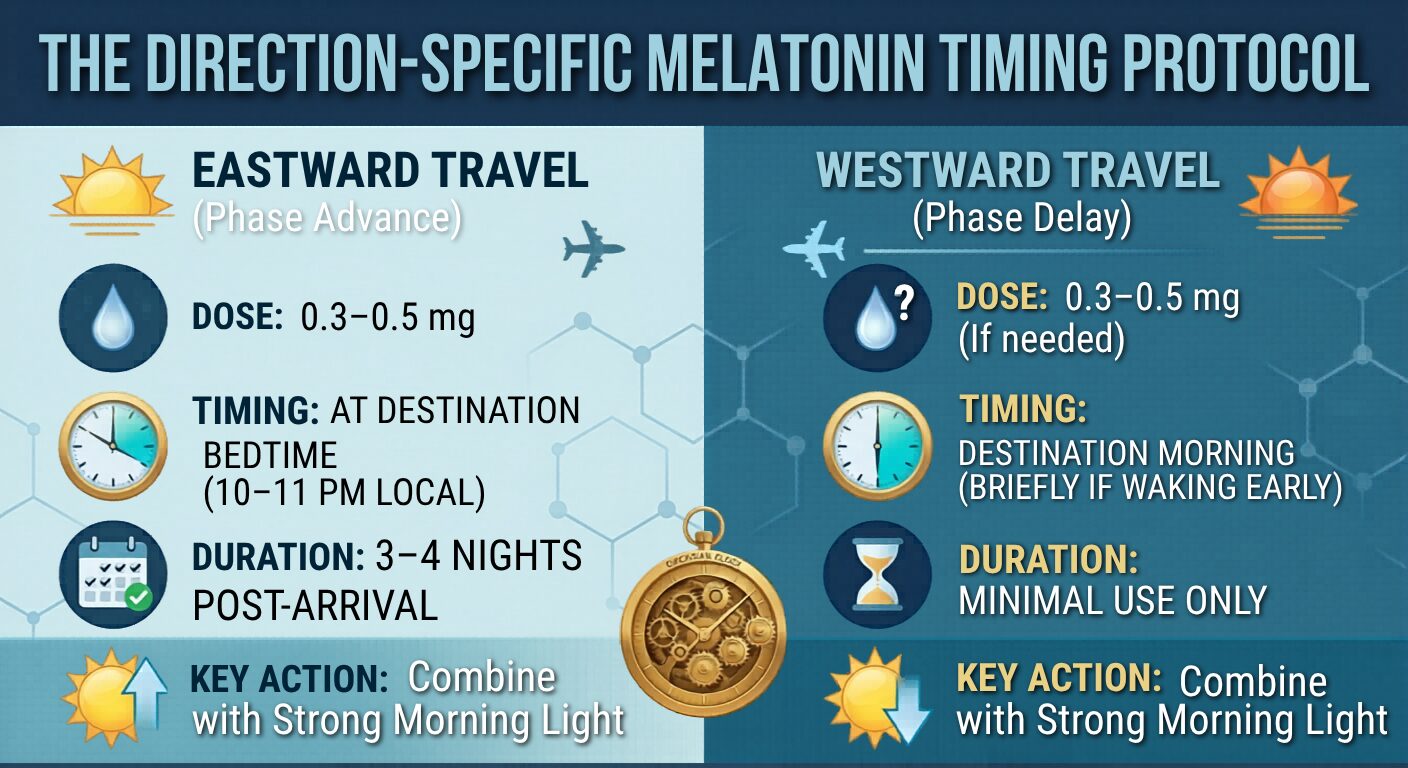
Eastward Travel (Advancing Your Phase)
Flying east across time zones — New York to London, Los Angeles to Tokyo, Toronto to Paris — requires advancing your circadian phase. Your body needs to be ready to sleep earlier than it’s used to. Melatonin helps by providing an earlier evening signal:
- Dose: 0.3–0.5 mg sublingual or fast-release
- Timing: at destination bedtime (typically 10:00–11:00 p.m. local) for 3–4 nights after arrival
- Pre-departure option: 0.3–0.5 mg about 5 hours before your normal bedtime in the days leading up to the trip, to pre-shift your phase earlier
- Combine with strong morning bright light at destination to maximize the phase advance
- Avoid bright light in the destination evening, which would counteract melatonin’s signal
Westward Travel (Delaying Your Phase)
Flying west — London to New York, Tokyo to Los Angeles — requires delaying your circadian phase. Your body needs to stay awake later than it’s used to. Westward travel is generally easier (the body naturally drifts later), and melatonin is often unnecessary. When used, the protocol is essentially reversed:
- Dose: 0.3–0.5 mg sublingual or fast-release
- Timing: in the destination morning if waking too early (typical westbound pattern), brief use only
- Most westbound travelers don’t need melatonin — strategic evening light at destination is usually sufficient
- Avoid taking melatonin at destination bedtime for westward travel — this can actually shift your clock the wrong way
- Combine with strong evening bright light at destination to support phase delay
Very Large Shifts (Transpacific and Similar)
For shifts approaching 12 hours, the distinction between advancing and delaying blurs — you can theoretically shift either direction. The practical approach: identify which direction your body will naturally tend (usually the direction with the smaller “clock distance”), then follow that direction’s protocol consistently. Mixing protocols (taking melatonin both morning and evening, for example) sends conflicting signals and usually worsens adjustment.
The Critical Timing Rules
Why Dose Matters Less Than Timing
This is the most important concept in melatonin use, and the one most people get wrong. Taking a high dose at the wrong time still moves your clock the wrong way. Taking a low dose at the right time moves your clock the right way. Time of administration is the variable that determines direction; dose only affects magnitude (and side effects). A 0.3 mg dose at the right time outperforms a 10 mg dose at the wrong time — by a significant margin.
Why Low Doses Are Better
- Equivalent or better phase-shifting compared to high doses
- Less daytime grogginess and morning hangover
- Closer to physiological levels (your natural nightly production is ~0.1–0.3 mg total)
- Lower risk of side effects (vivid dreams, headaches, mood effects)
- Reduces tolerance buildup with repeated use
Why Sublingual or Fast-Release

For phase-shifting purposes, you want melatonin to enter the bloodstream quickly and clear quickly — producing a sharp signal at the chosen time rather than a prolonged elevation. Sublingual tablets and fast-release capsules accomplish this. Extended-release or controlled-release formulations — designed for ongoing nighttime levels — are less appropriate for travel use, where you want a precise timing signal.
Combining Melatonin With Light
Melatonin alone is useful; melatonin combined with strategic light exposure is dramatically more effective. The two work synergistically when aligned and can cancel each other out when conflicting. The rules:
- Eastward (advancing): melatonin at destination evening + bright light in destination morning + avoid bright evening light
- Westward (delaying): bright light in destination evening + avoid bright morning light initially + melatonin minimal or only in destination morning if needed
The light protocol is actually more powerful than melatonin alone. If you have to choose, prioritize getting the light timing right — light is the strongest zeitgeber available to humans. Melatonin is a useful supplement to good light timing, not a substitute for it.
If you would like to see how we might be able to help you with this deeper, schedule a free consult here.

Common Mistakes to Avoid
- Taking high-dose melatonin (3–10 mg) and expecting better results than low doses — dose doesn’t help here
- Taking melatonin at the wrong time — sometimes worse than not taking it at all
- Using extended-release formulations for travel — wrong tool for the job
- Treating melatonin as a sleeping pill rather than a clock-setting signal
- Continuing nightly melatonin beyond the adjustment period (typically 3–4 nights post-arrival is sufficient)
- Combining melatonin with conflicting light exposure (taking it then staying up in bright light)
- Skipping the light protocol because you took melatonin — light matters more
What the Research Shows
Low-dose efficacy: Research comparing 0.3–0.5 mg with 3–5 mg melatonin doses consistently shows equivalent or better phase-shifting from low doses, with significantly less daytime grogginess and side effects.
Timing-direction relationship: Studies establish that melatonin’s phase-shifting effect depends on timing relative to the body’s endogenous melatonin window — administration before this window advances the phase, while administration after delays it.
Light-melatonin combination: Research confirms that combining strategic light exposure with melatonin produces larger phase shifts than either intervention alone.
Travel applications: Studies on jet lag specifically show that low-dose melatonin timed appropriately for direction of travel reduces both subjective jet lag symptoms and the time required for circadian adjustment.
Safety and Cautions
Melatonin is generally well-tolerated, particularly at low doses, but several cautions apply:
- Not recommended during pregnancy or breastfeeding without medical guidance
- Can interact with blood thinners, blood pressure medications, immunosuppressants, and diabetes medications — review with your prescriber
- May affect hormonal contraceptive metabolism in some individuals
- Use during adolescence has been less studied — consult a healthcare provider
- Some people experience vivid dreams, headaches, or next-day grogginess (more common at higher doses)
- Quality varies between supplement brands — choose third-party tested products
This article is educational and not medical advice. Discuss supplementation with a knowledgeable practitioner, particularly when taking other medications or for ongoing use.
If you would like to see how we might be able to help you with this deeper, schedule a free consult here.
When to Seek Professional Help
Consider professional consultation if:
- You’re using melatonin nightly and want to evaluate long-term use
- Travel-related sleep issues persist despite optimized melatonin and light protocols
- You have conditions or medications that may interact with melatonin
- Your frequent travel is producing chronic disruption that protocols alone aren’t resolving
- You want an individualized protocol for your specific routes and physiology
Frequently Asked Questions
When should I take melatonin for international travel?
For eastward travel (advancing phase): at destination bedtime, around 10–11 p.m. local, for 3–4 nights after arrival. For westward travel (delaying phase): usually not needed; if used, take in destination morning briefly if waking too early. Timing matters far more than dose — a low dose at the right time outperforms a high dose at the wrong time.
What is the best melatonin dose for jet lag?
0.3–0.5 mg sublingual or fast-release. The high doses (3–10 mg) sold in drugstores produce more sedation but not better phase-shifting — the receptors are already saturated at much lower doses. Low doses are closer to your body’s natural production (~0.1–0.3 mg per night), produce equivalent phase-shifting, and cause significantly less daytime grogginess.
Does melatonin work as a sleeping pill?
Not really. Melatonin functions as a circadian phase-shifting agent — a signal that tells your master clock what time it is — not as a hypnotic that forces sleep. Used as a sleeping pill (high doses to knock you out), it produces sedation without much circadian benefit and lingering grogginess. Used correctly (low doses at strategic times), it shifts your rhythm to align with new conditions.
Should I take melatonin going east or west?
Eastward travel benefits most from melatonin — taken at destination bedtime to advance your phase earlier. Westward travel is generally easier and often doesn’t require melatonin; strategic evening light at destination usually suffices. If used for westward travel, take in destination morning, not bedtime — taking it at bedtime can shift your clock the wrong way.
How long should I take melatonin when traveling?
Typically 3–4 nights post-arrival is sufficient for the circadian shift to take hold. Once your body has adjusted to destination time (signaled by falling asleep naturally and waking at appropriate times), discontinuing melatonin lets your natural production resume. Continuing melatonin nightly beyond the adjustment period isn’t necessary and may produce tolerance over time.
When to Work With a Sleep Consultant
Melatonin used correctly is a precise tool for managing international travel; used incorrectly, it’s an underwhelming sleep aid. The key reframe is treating it as a clock-setting signal rather than a sedative. Low dose, right timing, combined with proper light exposure, produces dramatically better travel adjustment. When frequent travel is producing chronic disruption that protocols alone don’t resolve, individualized work often identifies the accumulated dysfunction or underlying factors that need addressing alongside the travel optimization.
Riley Jarvis at The Sleep Consultant works with clients to uncover the root biological causes behind chronic sleep issues and build personalised protocols that address every layer — not just the symptoms.


