

Standard CBT-I runs six to eight sessions, usually weekly or every other week. Improvement typically does not show up until about three to four weeks in. Most people see a clear change by six to eight weeks. About 70 to 80 percent of people respond to treatment, and about 40 percent reach full remission. Your first one or two weeks can feel rough, because sleep restriction trims your time in bed before it helps your sleep. The benefits tend to last, with studies showing gains at 6 to 24 months and beyond. This is educational information, not medical advice.
Short answer (40-60 words): CBT-I usually takes six to eight weekly or biweekly sessions. Most people notice improvement around week three or four and see clear results by week six to eight. About 70 to 80 percent respond, and about 40 percent reach full remission. The first two weeks can feel harder before sleep improves.
How Many Sessions Does CBT-I Take?
Standard CBT-I runs six to eight sessions. Sessions last 30 to 90 minutes, and clinicians usually schedule them weekly or every other week. Some trials use a shorter format, such as four biweekly sessions over eight weeks. Delivery can happen in person or online. Our CBT-I guide explains each component.
A Typical Week-by-Week Timeline
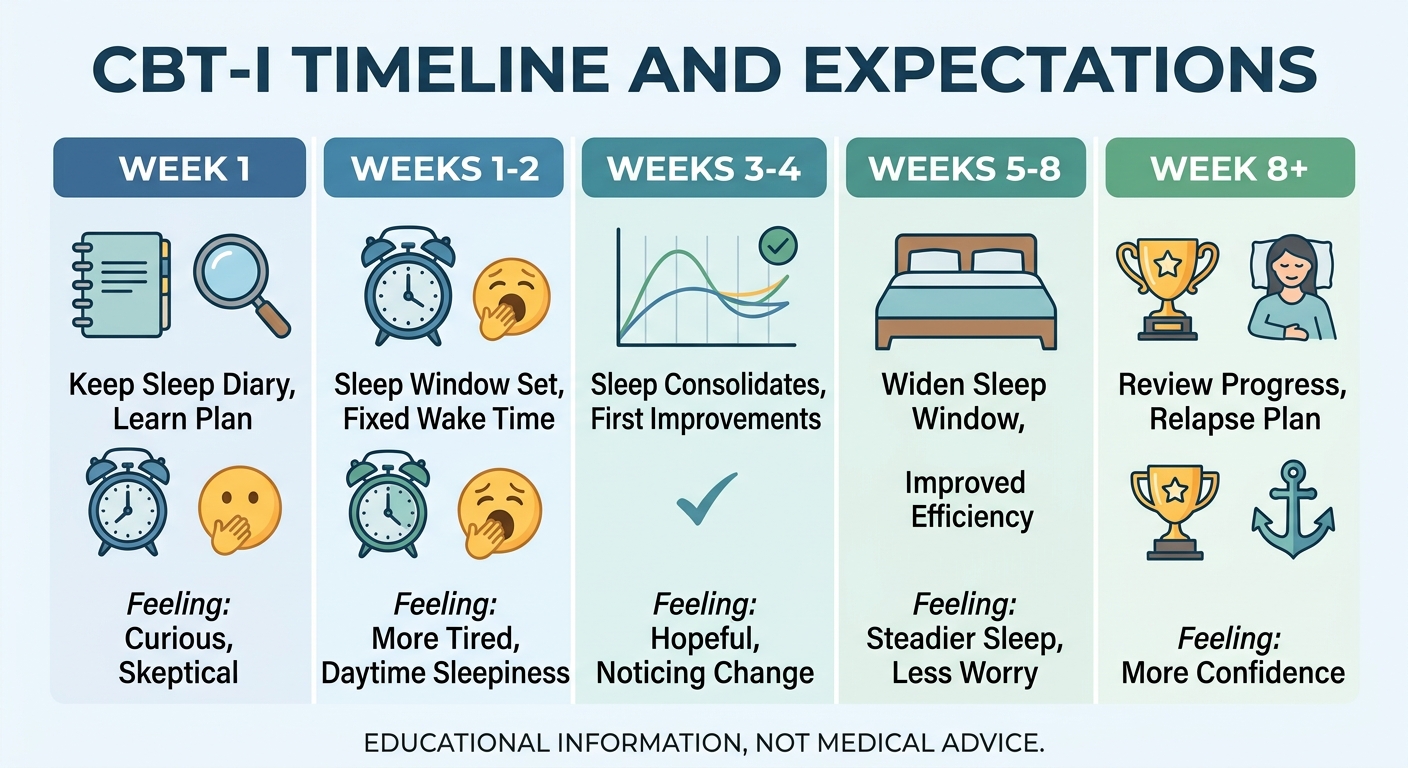
Every plan differs, and a clinician adjusts yours to your sleep data. This timeline shows the usual pattern.
| Weeks | What Usually Happens | What You May Feel |
|---|---|---|
| Week 1 | You keep a sleep diary and learn the plan | Curious, maybe skeptical |
| Weeks 1 to 2 | Your clinician sets a sleep window based on your diary, and you fix your wake time | More tired than usual; daytime sleepiness often rises first |
| Weeks 3 to 4 | Your sleep starts to consolidate | First real improvements, per a systematic review |
| Weeks 5 to 8 | You widen your sleep window as your efficiency improves, often by about 15 minutes a week | Steadier sleep, less worry about bedtime |
| Week 8 and beyond | You review progress and build a relapse plan, often with a follow-up around three months | More confidence that you can handle a bad night |
The review behind the week 3 to 4 estimate comes from a systematic review of CBT-I trials. It reported that improvements are typically not seen until three to four weeks into treatment. That matters because many people quit at week two, right when sleep restriction feels hardest. Read our sleep restriction guide to see why.
What Are the Real Success Rates?

Reported figures run as follows:
- Response: About 70 to 80 percent of people improve meaningfully.
- Remission: About 40 percent reach clinical remission, meaning their insomnia no longer meets the clinical threshold.
Read those two numbers together. A 70 to 80 percent response rate means most people get better. A 40 percent remission rate means that many do not become symptom-free. CBT-I is highly effective, but it does not work equally for everyone, and some people need extra support.
How Does the Timeline Compare With Sleeping Pills?
Pills can work faster. In the first four to eight weeks, CBT-I performs about as well as sedative medications. After that, the difference grows. A CBT-I primer reports it works better than sleeping pills when you measure three or more months after treatment. Meta-analytic data show clinically significant effects at one year, and a follow-up of one randomized trial showed persisting benefits after ten years. Medication benefits generally fade when the pills stop. See our treatment comparison.
What Slows Progress?
A few things commonly slow results:
- Skipping the sleep diary. Your sleep window depends on accurate data.
- Inconsistent wake times. A fixed wake time anchors your clock.
- Napping. Naps weaken the sleep drive that CBT-I builds.
- Quitting early. Many people stop before the three-to-four-week mark.
- Other conditions. Untreated sleep apnea, depression, or pain can limit results.
- Going alone. Therapist-supported programs outperform fully automated ones, per a 2025 meta-analysis. See online sleep coaching.
Who Should Not Do CBT-I Without Medical Guidance?
Sleep restriction can trigger mania or hallucinations in some people. Get clinical supervision first if you have bipolar disorder, psychosis, or seizures, or if you drive or operate machinery for work. Our guide to finding a specialist explains how to choose a qualified provider.
If you take sleeping pills now and want to come off, CBT-I can help. Read how to stop sleeping pills safely and plan the taper with your prescriber.
What the Research Shows
Standard CBT-I takes six to eight sessions. Sources describe weekly or biweekly sessions lasting 30 to 90 minutes, with some trials using shorter formats.
Gains usually start around week three or four. A systematic review found improvements typically do not appear until three to four weeks into treatment.
Response is high, remission is lower. About 70 to 80 percent respond and about 40 percent reach full remission.
Benefits last. Meta-analytic data show clinically significant effects at one year, studies show maintained gains up to 24 months, and one trial follow-up showed benefits after ten years.
This article is for educational purposes only and is not a substitute for personalized medical advice, diagnosis, or treatment.
If you would like to see how we might be able to help you with this deeper, schedule a free consult here.
Want a Free Starting Point?
Join the free sleep course and community: Join the Sleep Nirvana Club
When to Seek Professional Help

- Your insomnia has lasted three months or longer
- You have bipolar disorder, seizures, or a history of psychosis
- You snore loudly, gasp, or feel very sleepy during the day
- You feel worse after two to three weeks of a sleep restriction plan
- Low mood or anxiety comes with poor sleep
Frequently Asked Questions
How long does it take for CBT-I to work?
Most people notice improvement around three to four weeks, and clear results by six to eight weeks. A systematic review reports gains typically do not appear until three to four weeks into treatment.
How many CBT-I sessions do I need?
Standard CBT-I runs six to eight sessions, usually weekly or every other week. Some trials use as few as four biweekly sessions. Your clinician adjusts the plan to your progress.
Does CBT-I make sleep worse before it gets better?
Often, for the first one to two weeks. Sleep restriction trims your time in bed to build sleep drive, so many people feel more tired at first. That is expected, and it usually eases as your sleep consolidates.
What is the success rate of CBT-I?
About 70 to 80 percent of people respond to treatment, and about 40 percent reach full remission. That means CBT-I helps most people, but not everyone becomes symptom-free.
Do the results last after CBT-I ends?
Usually. Meta-analytic data show clinically significant effects at one year, studies show gains maintained up to 24 months, and a trial follow-up showed benefits after ten years.
When to Work With a Sleep Consultant
CBT-I asks for six to eight weeks, and most of the payoff arrives after the hard first stretch. If you want a guide for that stretch, we can help.


